
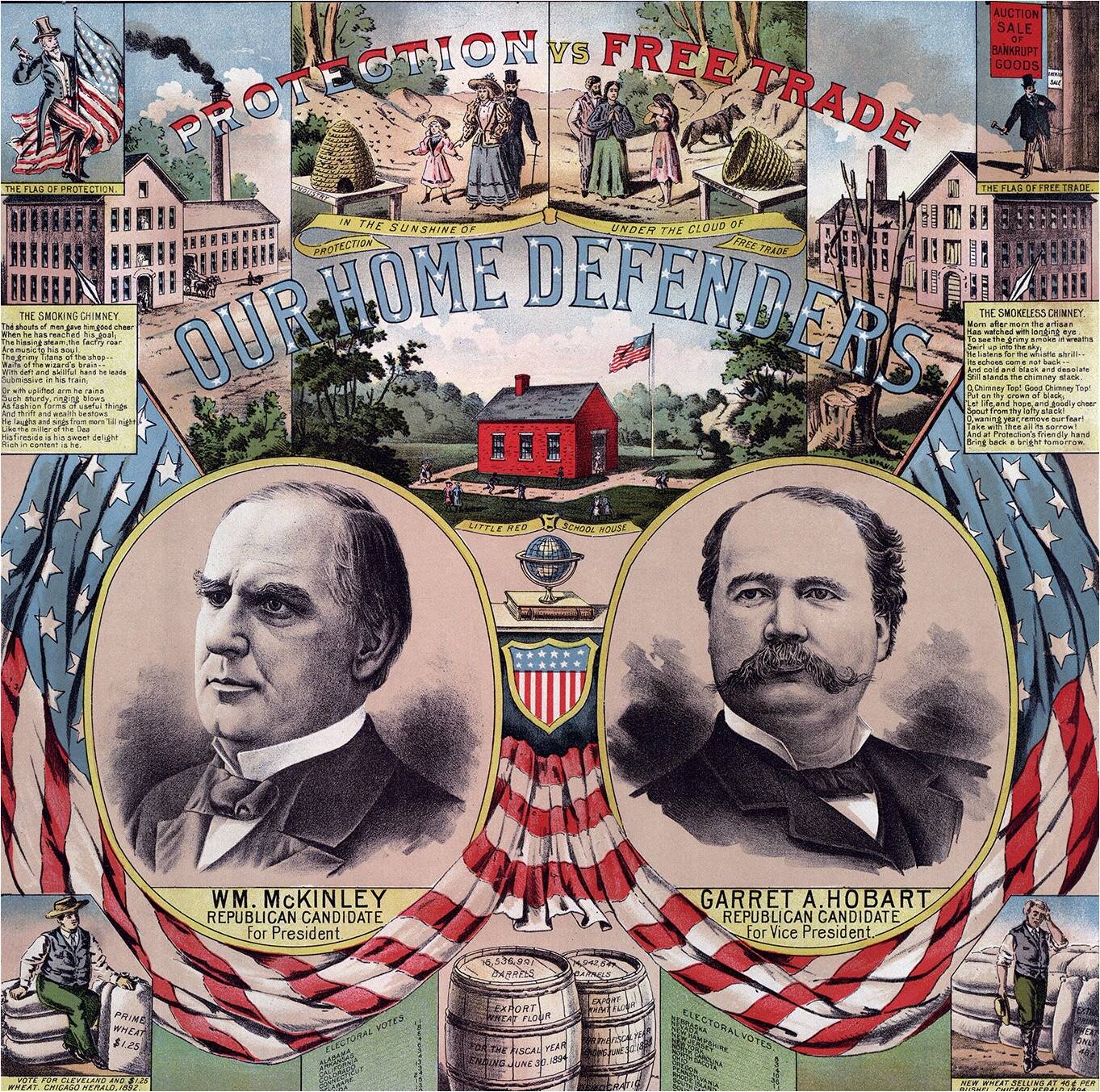
Trump admires William McKinley and his high tariffs
Protectionism Is Cool Again
Donald Trump promised to cry havoc in November 2024 as President-elect, and he hath now as President let loose the dogs of tradewar. Trump had denounced the tradedeficit between Canada and the United States, which have occurred under the trade agreement between Canada, the United States, and Mexico that he negotiated during his first non-consecutive term.[1] But the Doctrine of Trumpian Infallibility dictates that he somehow bears no responsibility for the trade agreement that he initiated and secured eight years ago and which he now finds bad.
NAFTA was always NAFTA in English, ALÉNA en français, and TLCAN en español, but this newer trade agreement that Trump forced in his first term reflects the post-truth era of caprice and stupidity in which we live, because we cannot agree on something as basic as the name of this trilateral agreement. Canada in English calls it “The Canada-United States-Mexico Agreement (CUSMA)”, while in Washington the agreement identifies itself as “The United States-Mexico-Canada Agreement.” The trilateral international Secretariat charged with administering the treaty between the three countries also gives it different names in English, French, and Spanish. In English, “The Agreement” identifies as both the “Canada-United States-Mexico Agreement (CUSMA) / United States-Mexica-Canada Agreement (USMCA).” The Mexicans call it El Tratado entre México, Estados Unidos y Canadá (T-MEC), simply “The Treaty between Mexico, the United States, and Canada.” And Canada also calls it in French by Accord Canada – États-Unis – Mexique – a direct translation of the Canadian English name shorn of the preposition which elegantly marks the Spanish, which surprises me given the prevailing pedantry that French-speakers usually show toward their language.
On 1 February 2025, Trump issued an executive order under Article II of the US Constitution and delegated legislation pursuant to the International Emergency Economic Powers Act, the National Emergencies Act, the Trade Act, and the United States Code to impose a tariff of 25% on all Canadian goods and products except energy, which he shall merely tariff at a rate of 10%, as of 4 February.
Sec. 2. (a) All articles that are products of Canada as defined by the Federal Register notice described in subsection (e) of this section (Federal Register notice), and except for those products described in subsection (b) of this section, shall be, consistent with law, subject to an additional 25 percent ad valorem rate of duty. Such rate of duty shall apply with respect to goods entered for consumption, or withdrawn from warehouse for consumption, on or after 12:01 a.m. eastern time on February 4, 2025 […]
(b) With respect to energy or energy resources, as defined in section 8 of Executive Order 14156 of January 20, 2025 (Declaring a National Energy Emergency), and as otherwise included in the Federal Register notice, such articles that are products of Canada as defined by the Federal Register notice shall be, consistent with law, subject to an additional 10 percent ad valorem rate of duty. Such rate of duty shall apply with respect to goods entered for consumption, or withdrawn from warehouse for consumption, on or after 12:01 a.m. eastern time on February 4, 2025 […].[2]
Most ominously still, Trump issued an open declaration of tradewar and warned Canada not to retaliate, or else he might escalate the tariffs yet further:
(d) Should Canada retaliate against the United States in response to this action through import duties on United States exports to Canada or similar measures, the President may increase or expand in scope the duties imposed under this order to ensure the efficacy of this action.[3]
This executive order only applies to Canada, which presumably means that Trump will soon issue additional executive orders imposing tariffs on Mexico separately. CUSMA – I’ll use the Canadian variant of the name here, I suppose, purely because it makes a pronounceable acronym – came into effect in December 2019, shortly before the pandemic.[4] Trump has, in effect, abrogated that Treaty unilaterally, killed free trade in North America, and undone decades of good will.
And yet this is not the first time that the United States has abruptly cancelled free trade and re-imposed protectionist tariffs on Canada either. In some ways, Trump has brought the United States back to its protectionist norm.
Some Historical Precedents
Governor General Lord Elgin brokered a trade deal on behalf of all British North America (not merely the Province of Canada) the United States, and the United Kingdom in 1854. The US Congress, the Imperial Parliament, the Parliament of the Province of Canada, and the legislatures of New Brunswick, Nova Scotia, Prince Edward Island, and Newfoundland all ratified the agreement in 1854 and 1855.[5] The Reciprocity Treaty of 1855 to 1866 allowed the free trade of some natural products – such as timber, grains, foodstuffs, livestock, eggs, pelts, wool, dairy, fish, minerals, and coal – between the United States and all the self-governing colonies of British North America. The treaty also allowed American vessels to navigate the St. Lawrence and Canadian canals while paying the same tolls as British North American ships and gave British North American ships access to Lake Michigan. The treaty meant higher profits for Canadian producers, who could sell cheaper goods to American consumers. Total trade between British North America and the United States increased from $32.8 millions per year in 1854 to $42.8M in 1855 and $50.3M in 1856.[6]
Both British North America and the United States possessed most of the same natural products, so the Reciprocity Treaty encouraged the British North American colonies to obtain things from the adjacent American states instead of far-flung British North American colonies and vice versa, though British North America ended up providing the US with more lumber.[7] By Trump’s logic, the US therefore “subsidised” British North America for lumber. Article V said that “the treaty shall remain in force for ten years” after which time “each of the contracting parties” could give one year’s notice to abrogate the treaty. Both protectionism in the industrial northeast of the United States and resentment toward the Province of Canada and the United Kingdom during the Civil War rose in the 1860s, and the US Congress decided to withdraw from the agreement in 1865 to take effect in 1866.[8] Even here then, British North America, on the verge of federating in the Dominion of Canada, had at least one year’s notice before losing access to American markets.

I can’t be the only one who sees the likeness between Canadian journalist Lawrence Martin and American politician Henry Clay
A few weeks ago, I bought Lawrence Martin’s old tome The Presidents and the Prime Ministers – Washington and Ottawa Face to Face: The Myth of Bilateral Bliss, 1867-1982 to give an overview of Canada’s bilateral relations with the United States. Incidentally, Lawrence Martin bears more than a passing resemblance to Henry Clay, and 19th-century Congressman, Senator, and Secretary of State and the architect of the “American System” of tariffs and “internal improvements” which might have inspired Sir John A. Macdonald’s “National Policy” of the same objectives for Canada.
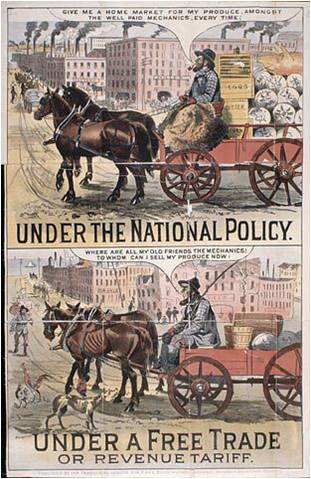
The pro-tariff factions of the Canada and the United States relied on similar political propaganda, showing citizens prospering under tariffs and ordinary workers and farmers left destitute under free trade.
Martin focused on the personal relationships between various American Presidents and Canadian Prime Ministers, which strikes me as the correct approach given the latitude that heads of government hold over the conduct of diplomacy and war. Martin then broke down these years into four distinct periods:
- 1867-1912: “Annexationist Presidents and Powerless Prime Ministers”
- 1913-1932: “Aloof and Indifferent Presidents”
- 1933-1960: “The Good Neighbour Era”
- 1961-1982: He gave it no name, but apart from the brief overlap between Pearson and Kennedy and Trudeau and Carter, these years saw a great deal of tension and strained relations.[9]
If he wrote a second edition of the book today, perhaps he could add the following eras:
- 1984-2001: The Return of the Good Neighbour Era
- 2001-2017: Overall Good Relations With Less Effusive Mutual Praise in Public
- 2017-present: The Revenge of Protectionism and Bilateral Irritants
Ulysses Grant and Rutherford Hayes wanted to annex Canada, and William Taft promoted the tentative reciprocity agreement that he had negotiated with Laurier as the prelude to annexation, but the United States in this era settled on imposing high tariffs on Canada, which, in turn, spurred Sir John A. Macdonald to establish the National Policy in Canada of protective tariffs, building railways, and bringing immigrants to the Prairies.[10]
The eras of close and productive relationships – and even friendships – between American Presidents and Canadian Prime Ministers stand out as aberrations. My cohort and I came of age watching Jean Chretien and Bill Clinton play golf together and place friendly bets and exchange hockey jerseys with one another.
One of Chretien’s funniest moments happened at a joint press conference with Bill Clinton in 1997 when the two promoted free trade and Chretien misheard “drugs” as “trucks.”
Bill Clinton praised Jean Chretien, Canada, and free trade in 1997 at a state dinner at the White House.
A bit before my time, Brian Mulroney famously (or infamously) sang “These Irish Eyes Are Smiling” with Ronald Reagan on stage at the so-called Shamrock Summit in Quebec City in 1985.
Ronald Reagan later praised Brian Mulroney, Canada, and free trade in 1988 at a state dinner at the White House.
I felt genuinely wistful watching these archival videos, all the more so because we shall not see the likes of these duos and strong Canadian-American relations again for a while.
Conclusion
Sadly, Donald Trump has brought the United States back to its isolationist default, where it has in many ways yearned to return ever since the Soviet Union dissolved in 1991. We in Canada might feel spurned in the same way that one does when events at work make one understand that one’s coworkers or managers are not one’s friends.
I remain utterly unconvinced that imposing retaliatory tariffs and seconding Trump’s declaration of tradewar makes any sense at all, because this action ultimately most harms Canadians who buy things by making them pay more for basic goods and could also therefore increase inflation here. And Trump also threatened to retaliate if Canada imposed counter-tariffs, which means that we could become locked in a series of ever-escalating tariffs which hurt Americans and Canadians alike yet further and without end until a change of government.
In 1930, the United States imposed the second-highest tariffs in its history and only deepened the Great Depression as a result. R.B. Bennett likewise increased Canada’s tariffs on American goods, ostensibly as a ploy to bargain away in tit-for-tat negotiations with Washington. Unfortunately, neither Herbert Hoover nor Franklin Roosevelt showed much willingness to negotiate with Bennett. While Bennett helped broker Imperial Preference at the Commonwealth Conference that he hosted in Ottawa in 1932, he failed to achieve a trade agreement with the United States.[11] Bennett visited Roosevelt in Washington in April 1933 and expressed an interest in lowering tariffs, but talks did not get underway until August 1935, just before the federal election here in Canada held in October. Roosevelt dragged out negotiations until after Canada’s election in the hope that he would obtain better terms from King.[12] King and Roosevelt announced only one month after the election in November 1935 a new trade agreement in which Canada and the United States gave each other Most Favoured Nation status and reduced some tariffs against one another.[13]
I would draw two important lessons from this historical precedent: first, tariffs only hurt us, Canadians who buy things, and that second, imposing retaliatory tariffs against the United States in the hopes that they will force Washington to negotiate fails is sheer folly and arrogance. As Lawrence Martin demonstrates in his book, the personalities of the American President and Canadian Prime Minister – and mostly that of the American President, because we have always needed them more than they have needed us overall – matter most in determining the success of the bilateral American-Canadian relationship. David MacKenzie likewise showed as much in his recent book King and Chaos: The 1935 Canadian Election.
But the outgoing, lame-duck Trudeau government has decided to impose tariffs on a whole host of basic foods imported from the United States,[14] which, as always, will inevitably hurt Canadian consumers, especially the poor and those amongst us already struggling to make ends meet, which includes a distressingly larger proportion of the population compared pre-Pandemic. These tariffs as of February 4th shall apply to diary, eggs, tomatoes, “leguminous vegetables and nuts,” coffee and tea, citrus fruits; spices like pepper, vanilla, and cinnamon; grains like wheat, rye, barley, oats, and rice, as well as pasta, shellfish, and sausages. The Liberal even thought that slapping tariffs on – and therefore making more expensive for the consumer –American toiletpaper and papertowel, only five years after we all endured undignified and desperate shortages of those things in the early part of the Pandemic, seemed like a jolly good idea.[15] Politicians always wish to make themselves seen as doing something, even when doing nothing amounts to the wisest choice.
Where William Gladstone’s (classical) Liberals in the United Kingdom became hugely popular with working-class voters when they eliminated tariffs on basic foodstuffs and made life more affordable, Justin Trudeau’s Liberals wish to make themselves seem tough and have deluded themselves into believing that Trump will negotiate tit-for-tat with an outgoing and unpopular government, which must go to the polls in October 2025 at the latest, if only they impose massive tariffs of 25% on basic goods and hurt Canadian consumers over the next few months. Dominic LeBlanc’s Department of Finance solemnly informs us that these retaliatory tariffs of 25% of American goods – or “countermeasures,” as he downplays them – “have one goal: to protect and defend Canada’s interests, consumers, workers, and businesses.”[16] But they will do so such thing and will inevitably and especially hurt Canadian consumers most of all. The egos of Donald Trump and Justin Trudeau matter most and above all, and the rest of us shall literally pay the price. Dominic LeBlanc’s press release even unconsciously and presumably accidentally mimics Trump’s aggrieved style of speaking, boasting that we shall impose tariffs “in response to unjustified U.S. tariffs.” I can almost hear Trump’s voice as I read it and imagine his diddies like, “these very unfair tariffs – and a lot of people are saying that, by the way.”
Canada has faced the same barriers from the United States before and survived, and we will survive this latest bout of protectionist plague from Washington, too. One selfish fool now holds us all hostage to his wounded pride and ever-shifting whim; we have to wait until Trump and Trudeau have left office before finding better terms.
I lament this terrible tradewar, which will succeed only in harming the most vulnerable who already struggled before and shall now surely struggle to pay 25% more for basic foodstuffs and other essentials. I feel so angry at and ashamed of all this posturing and stupidity engulfing North America today. We are making ourselves poorer, pettier, crueler, and dumber, all while emboldening our strategic and geopolitical adversaries like China.
Similar Posts:
- A Time When America Would Have Given Us Seven States (December 2024)
- Thomas D’Arcy McGee on Literature as National Identity (December 2020)
- Manifest Destiny Hijacks the Monroe Doctrine: A Bill to Annex Canada (August 2020)
- Canada: A Shining City on a Hill for American Losers (June 2020)
- Thomas D’Arcy McGee on The Constitution of the Confederate States of America (April 2020)
- The Dominion of Canada in 1897 (October 2018)
- Canada’s Counter-Manifest Destiny (July 2018)
- George Brown and Canada’s Manifest Destiny (July 2017)
- Some Thoughts on National Parks in Canada and the United States and Manifest Destiny (March 2017)
- 1774: Thomas Jefferson and the Rights of British Americans (September 2011)
Notes
[1] Gigi Suhanic, “Posthaste: 5 Charts That Challenge Trump’s Trade Tirades about Canada,” Financial Post, 24 January 2025.
[2] United States of America, Office of the President, Executive Order: “Imposing Duties to Address the Flow of Illicit Drugs Across Our Northern Border,” 1 February 2025.
[3] Ibid.
[4] CNN, “6 Key Differences Between NAFTA and the USMCA Deal That Replaces It,” 17 December 2019.
[5] D.C. Masters, Reciprocity, 1846-1911, Historical Booklet No. 12 (Ottawa: The Canadian Historical Association, 1983), 6-7.
[6] D.C. Masters, Reciprocity, 1846-1911, Historical Booklet No. 12 (Ottawa: The Canadian Historical Association, 1983), 7-9.
[7] Masters, Reciprocity, 9-10.
[8] Masters, Reciprocity, 11.
[9] Lawrence Martin, The Presidents and the Prime Ministers – Washington and Ottawa Face to Face: The Myth of Bilateral Bliss, 1867-1982 (Toronto: Doubleday Canada, 1982), 13-15.
[10] Martin, The Presidents and the Prime Ministers, 36.
[11] David MacKenzie, King & Chaos: The 1935 Canadian General Election (University of British Columbia Press, 2023), 24.
[12] MacKenzie, King and Chaos, 97.
[13] MacKenzie, King and Chaos, 202.
[14] Government of Canada, Department of Finance, “List of Products from the United States Subject to 25 Percent Tariffs Effective February 4, 2025,” 2 February 2025.
[15] Sam Thompson, “Canada’s Retaliatory Tariffs: Here’s the List of Targeted Items,” Global News, 2 February 2025.
[16] Government of Canada, Department of Finance, “News Release: Canada Announces $155 B Tariff Package in Response to Unjustified U.S. Tariffs,” 1 February 2025.

 James Bowden's Blog