
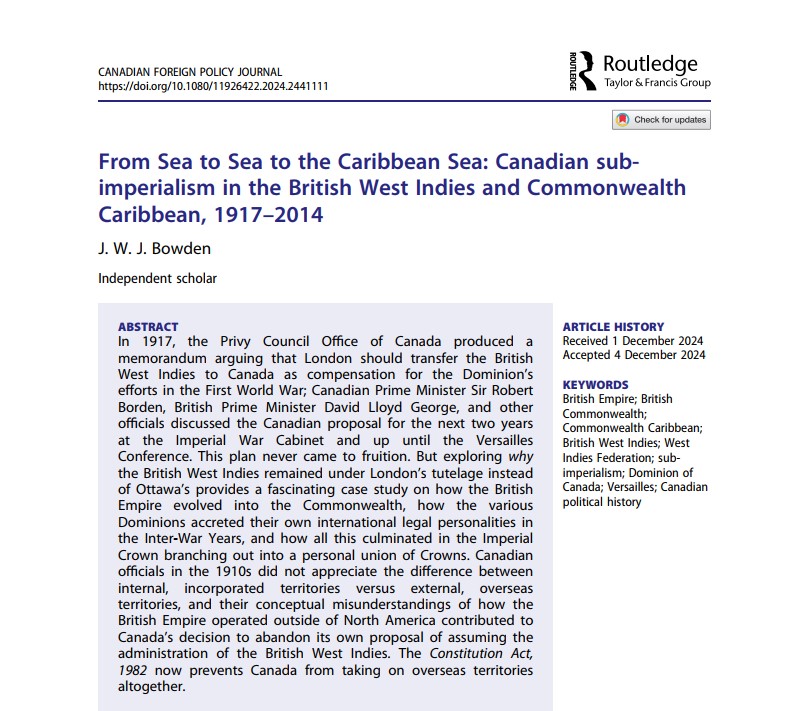
The Canadian Foreign Policy Journal pleasantly surprised me on 18 December by publishing the electronic version of my article “From Sea to Sea to the Caribbean Sea: Canadian Sub-Imperialism in the British West Indies and Commonwealth Caribbean, 1917-2014.” I had forgotten that Taylor and Francis’s journals tend to publish an article online separately before releasing it as part of its main issue in print and online later.
Now safely concealed within the fortress of Taylor and Francis, I can only provide a brief overview of the project.
A Basic Oveview
In 1917, Sir Joseph Pope of the Privy Council Office of Canada produced a memorandum arguing that London should transfer the British West Indies to Canada as compensation for its efforts in the First World War; Canadian Prime Minister Sir Robert Borden, British Prime Minister David Lloyd George, and other officials discussed the Canadian proposal for the next two years at the Imperial War Cabinet and up until the Versailles Conference. This plan never came to fruition. Exploring why the British West Indies remained under London’s tutelage provides a fascinating case study on how the British Empire evolved into the Commonwealth, how the various Dominions accreted their own international legal personalities in the Inter-War Years, and how all this culminated in the Imperial Crown branching out into a personal union of Crowns.
I found that Canadian officials in the 1910s did not appreciate the difference between internal, incorporated territories versus external, overseas territories, and their conceptual misunderstandings of how the British Empire operated outside of North America, which, at least in part, contributed to Canada’s decision to abandon its own proposal of assuming the administration of the British West Indies. Pope, Borden, and other cabinet ministers did not understand that external territories do not become part of the metropolitan polity and therefore do not obtain any representation in Parliament. For example, British subjects in Canada, Australia, New Zealand, South Africa, and Newfoundland, for instance in 1917 governed themselves in domestic matters and did not send MPs to the Westminster Parliament. The same would have applied to any Canadian overseas territories. If Canada had replaced the United Kingdom and British external territories in the Caribbean had become Canadian external territories in the Caribbean, then none of the inhabitants of the Caribbean islands of any race would have voted in elections to the House of Commons of Canada because that’s not how external territories work. Yet Borden and other ministers had soured on the idea that Canada would take on the British West Indies by 1919 after debating whether or not to grant black West Indians the vote. Therefore, a curious mixture of racism and ignorance of how the British Empire operated outside of North America made set Canada apart from Australia, New Zealand, and South Africa in the late 1910s. Australia, New Zealand, and South Africa had also captured German overseas territories during the Great War, while Canada did not became none existed in the Western Hemisphere thanks to the Monroe Doctrine.
Section 146 of the British North America Act contained a blueprint for annexing all other British possessions in North America to the Dominion of Canada as internal territories, but it contains nothing that would support external or overseas territories. Geopolitics forced the Dominion of Canada to become and remain a land empire that directly incorporates new territory instead of a maritime empire that takes on external territories overseas and holds them in the name of the Crown without incorporating them directly into the metropolitan polity. But Australia and New Zealand never suffered from this hang up. Nor did South Africa, oddly enough, despite being more like a land power. British Australasia retained the strong maritime culture of the United Kingdom itself, and Australian and New Zealand political elites therefore readily understood the concept of maritime empire and external territories. They kept the German territories that they captured in the First World War under the guise of Class-C League of Nations Mandates.
Consequently, the British Empire branched out into a series of sub-empires – hence what historians of this era call “sub-imperialism”– in the Inter-War Years. South Africa, Australia, and New Zealand even gave rise to their own independence movements separate from the United Kingdom. For instance, Namibia (the former German Southwest Africa) became an external territory of South Africa, went along for the ride when South Africa went from Realm to republic in 1961, and gained its independence from South Africa in 1988, not the United Kingdom. Samoa never became part of the Dominion of New Zealand and gained its independence from New Zealand, not the United Kingdom, in 1964; similarly and most extraordinarily of all, Papua New Guinea gained its independence from Australia, not the United Kingdom, and then became a Commonwealth Realm in its own right in 1975. None of the other 14 Realms of which Charles III is King originated in this manner; the others all gained their independence from the United Kingdom. This raises the interesting prospect that if Canada had taken on the British West Indies as overseas territories in the 1910s, it is therefore entirely possible that Ottawa would have mishandled their administration so badly and alienated the people of those islands so thoroughly that Antigua & Barbuda, the Bahamas, Barbados, Belize, Dominica, Grenada, Guyana, Jamaica, Saint Kitts & Nevis, Saint Lucia, and Saint Vincent & the Grenadines, and Trinidad & Tobago might have achieved independence from Canada from the 1960s to the 1980s instead of from the United Kingdom.
The Constitution Act, 1982 Bans Canadian Overseas Territories
Half-hearted efforts at Canadian-Caribbean union persisted for another century and focussed between the 1970s and 2010s on annexing Turks & Caicos Islands. I am still not sure why Canadian politicians fixated on Turks & Caicos Islands over and above Anguilla, the British Virgin Islands, the Cayman Islands, Montserrat, the other remaining British Overseas Territories in the Caribbean; as far as I can tell, it is purely arbitrary. At any rate, these more recent and contemporary efforts have failed (from the Canadian viewpoint) because Canadian elites show a callous disregard for the democratic self-determination of Turks & Caicos Islanders themselves as well as a strange ignorance of the statutory or constitutional amendments post-1982. Section 3 of the Charter of Rights and Freedoms, which guarantees every Canadian citizen the right to vote and to be represented in the House of Commons, makes the concept of a Canadian overseas territory impossible – given that overseas territories, by definition, do not gain representation in the parliament of the metropole. So Turks & Caicos Islands would have to become the fourth internal territory or the eleventh province. The Constitution Act, 1982 therefore cemented Canada as a landempire and precludes Canada from ever acquiring overseas territories along the British model, though perhaps not under the French model of departments d’outre-mer.
The Vicissitudes of Fate in Academic Publishing
Like my other recent article on why John Turner genuinely believed that he “had no option” in 1984, this manuscript comes with an interesting story. I first became aware of Pope’s memorandum over a decade ago and had to let that sink in for while; the ancestor of this paper then went on a strange journey and veritable odyssey for several years. It first came close to publication in 2019-2020. The Commonwealth Law Bulletin, which had also accepted my article criticising the Department of Justice’s practice of “indirect amendment” of the Constitution Acts, put the manuscript out for peer review; I then went through the revise-and-re-submit after implementing the proverbial and literal Reviewer 2’s comments and making significantly changes. As frustrating as this sort of thing can feel in the moment, I found the reviewer’s critique constructive and greatly improved my argument by invoking Andrew Lambert’s concept of “seapower culture” (or seapowerculture, as I like to write in a fit of German-style agglutination) to contrast the political elites of the United Kingdom, Australia, and New Zealand on the one hand and those of Canada on the other. The manuscript probably would have appeared in 2020, but the Commonwealth Law Bulletin became defunct and stopped publishing altogether.
I had accepted this sad turn of events during the pandemic and let the manuscript lie fallow for a while. One journal desk-rejected it in 2021. The Journal of Imperial and Commonwealth History seemed like a natural fit; while the editor did not desk-reject it and intended to put it out for review, Taylor and Francis later informed everyone in the queue that the editor had taken ill, apologised for the delay, and invited us to withdraw our manuscripts and look elsewhere if we wished – which I accepted. (Thankfully, the JICH started uploading articles again in October and December 2024). I revised and re-submitted it again to the CFPJ as well, this time cutting it down by a few thousand words (though perhaps less than this other reviewer would have liked) and refining a few things. I’m just so glad that this project has finally appeared after all that!
Our Sister Caribbean Realms Make for Fascinating Comparative Research
- Constitution of the West Indies Federation
- Constitution of St. Vincent and the Grenadines
- Constitution of St. Kitts and Nevis
I also look forward to exploring more comparative studies between Canada and the Caribbean Realms. For too long, I have looked only to the United Kingdom, Australia, and New Zealand, but the more I learn about the new constitutions of the newer Commonwealth Realms in both the Pacific and the Caribbean, the more fascinating provisions worthy of consideration, emulation, or adoption here in Canada I see.
For instance, the constitution of the West Indies Federation, which only lasted from 1958 to 1962, clearly served as the blueprint for the constitutions of the Caribbean Realms which gained their independence from the United Kingdom from 1962 to 1983. These constitutions also take the British North America Act, 1867 and the Commonwealth of Australia Constitution Act, 1901 one step farther in codifying the basic precepts of Responsible Government. Section 39 of the Constitution of the West Indies Federation, for example, says that the Governor General dissolves the Federal Legislature “acting in accordance with the advice of the Prime Minister.”[1] Other provisions of this constitution, however, acknowledged that in other executive actions, the Governor General acts on the advice of the ministers collectively rather than the Prime Minister alone.[2] The West Indies Federation therefore simply codified the constitutional practice which existed in Canada at the time and still carries on to this day. And if only the British had adopted section 71 of this constitution for themselves! It preserves the non-justiciability of ministerial advice to the Crown. Then the British Supreme Court could never have issued its disastrous Miller 2 ruling that nullified Boris Johnson’s constitutional advice that Her Majesty the Queen prorogue parliament in 2019:
71. Where the Governor-General is required to exercise any function in accordance with the advice of the Council of State or of the Prime Minister, the question whether any, and if so what, advice has been tendered to the Governor-General by the Council of State or the Prime Minister, as the case may be, shall not be enquired into in any court.[3]
The constitutions of the successor Realms preserved this sort of wording which codifies the precepts of Responsible Government more clearly than do Canada’s or Australia’s written constitutions. The Constitution of Saint Christopher and Nevis, for instance, clearly spells out: “In the exercise of his or her powers to dissolve Parliament the Governor-General shall act in accordance with the advice of the Prime Minister.”[4] The Constitution of Saint Vincent and the Grenadines, which entered into force in 1979, contains a provision that the leaders of the Conservative Party, New Democratic Party, and Bloc quebecois would, as of 26 December 2024, find very interesting indeed:
47(2) a. If notice in writing is given to the Speaker signed by not less than three Representatives, of a motion of no confidence in the Government the Speaker shall
i) if the House is then sitting or has been summoned to meet within five days, cause the motion to be considered by the House within seven days of the notice; or
ii) if the House is not then sitting and has not been so summoned (and notwithstanding that Parliament may be prorogued) summon the House to meet within fourteen days of the notice and cause the motion to be considered at that meeting:
Provided that if the House does not, within twenty-one days of the notice, meet and dispose of the motion the Clerk of the House shall summon a special meeting of the House at such time and place as he may specify for the purpose of debating and disposing of the motion.
The provisions of paragraph (a.) of this subsection shall be without prejudice to the power of the House to provided by its rules of procedure that notice of a motion of no confidence in the Government may be given by any member of the House or the power of the House to debate and dispose of such a motion at any sitting of the House.[5]
In other words, open letters signed by leaders of political parties in Saint Vincent and the Grenadines do mean something, unlike here in Canada, and what happened in Canada last week would in our sister Caribbean Realm mean that the House of Commons would unadjourn earlier than originally planned. I also appreciate that this provision directs partyleaders to write the Speaker, not the Governor General. Some Canadian political scientists and journalists could stand to learn from this as well.
The Constitution Act, 1982 influenced the bill of rights contained in the Constitution of Saint Christopher and Nevis, which entered into force in 1983. In my view, Canada could, in turn, draw upon the Constitution of Saint Christopher and Nevis in some ways, such as the provision in section 30 which ensures a partisan balance of Senators. The Governor General appoints two-thirds of Senators on the advice of the Prime Minister but one-third on the advice of the Leader of the Opposition.[6] This sort of reform in Canada would better reflect the original Senate of the 1st Parliament after Confederation, where the Queen appointed the first crop of Senators under sections 27 and 127 of the British North America Act, 1867. The Legislative Councillors of Canada West and Canada East simply became the Senators for Ontario and Quebec, respectively, while politicians in New Brunswick and Nova Scotia nominated some of their provincial Legislative Councillors as Senators for their provinces.[7] This decision maintained a partisan balance between Conservatives and Liberals and government and opposition, and we should have had the foresight to codify some semblance of an opposition in the Senate through a minimum fixed proportion.
Similar Posts:
Notes
[1] The West Indies Federation Order-in-Council, at section 39.
[2] The West Indies Federation Order-in-Council, at section 60(1).
[3] The West Indies Federation Order-in-Council, at section 70.
[4] Constitution of Saint Christopher and Nevis, at section 47(4).
[5] Constitution of Saint Vincent and the Grenadines, at section 47(2) a.-b.
[6] Constitution of Saint Christopher and Nevis, at section 30(1).
[7] J.W.J. Bowden, “The Founders’ Senate And Ours: The Senate Was Always Meant to Be Partisan,” The Dorchester Review 9. no. 2 (Winter 2019): 56-59.

 James Bowden's Blog