
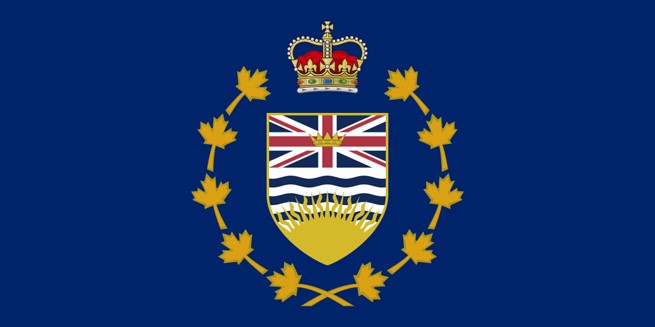
The Standard of the Lieutenant Governor of British Columbia
Journalists need to earn the trust of their viewers and readers. They could start by reporting on the basic foundations of Responsible Government in Canada correctly.
British Columbia, Saskatchewan, and New Brunswick have recently held general elections in accordance with the schedules set out in their respective fixed-date election laws. Nova Scotia will hold a snap general election in November after Premier Tim Houston decided to ignore the fixed-date elections law that he himself introduced in 2022.
On 21 October, New Brunswickers rejected the Progressive Conservatives of incumbent Premier Blaine Higgs and gave Susan Holt’s Liberals a clear majority.[1] Higgs even lost his own seat. By 23 October, the Government of New Brunswick’s website began referring to Susan Holt as the Premier-designate and announced on 29 October that the Lieutenant Governor will swear in Holt as Premier on 2 November 2024.[2] The media can at least handle transfers of power between different political parties after elections and did not need to propagate their egregious myth that premiers somehow stop being premiers during elections in the case of New Brunswick. But the close results in British Columbia and Saskatchewan betrayed their ignorance.
British Columbians went to the polls on 19 October; preliminary counts indicated a minority legislature in which the New Democrats of incumbent Premier David Eby had won 46 ridings compared to the 45 ridings of John Rustad’s Conservatives and 2 Greens.[3] In this legislature, 47 MLAs make a numerical majority, but a practical majority would amount to 48 so that the party in government can put up one of their own as Speaker. Elections British Columbia could not certify the results until 28 October after having counted all the special and absentee ballots, which showed the New Democrats with 47 MLAs, the Conservatives with 44, and the Greens with 2.[4] The New Democrats would probably still have to rely on the Greens once the new legislature meets, especially if they nominate a Speaker from their own ranks. This legislature might therefore not endure for the full four years.
The Canadian Press, Globe and Mail, and National Post erroneously reported that David Eby will “form the next government” despite his already being Premier. The National Post wrote: “B.C. NDP was declared victor and invited to form government by Lieutenant Governor Janet Austin.”[5] The Canadian Press declared: “British Columbia Premier David Eby has been asked by Lt.-Gov. Janet Austin to form the next government after a count of absentee votes gave his New Democrats a narrow win in the provincial election.”[6] The Globe and Mail noted: “NDP Leader David Eby met with the Lieutenant-Governor on Monday, and was asked to form the next government.”[7] But this is not what the Lieutenant Governor of British Columbia said. (The National Post even included a screenshot of the vice-regal press release and seemed ignorant of the contradiction, too). Janet Austin issued a press release on 28 October saying the following:
“As Lieutenant Governor of British Columbia, I have spoken with Premier David Eby, who has advised me that he is prepared to continue as Premier of British Columbia. This follows the outcome of the October 19, 2024, provincial election, having received today, October 28, 2024, assurances from Elections BC of the results of the final count.
I extend my thanks to all candidates who ran, and to those departing the Legislative Assembly for their dedicated service to the province.
I also wish to thank the entire team at Elections BC, and to express my gratitude to all British Columbians who voted and took time to participate in our democracy.”[8]
The Lieutenant Governor said that Eby “is prepared to continue as Premier,” not that she asked him “to form the next government.” Eby cannot, by definition, form the next government because he was already the Premier of British Columbia; he has been Premier since 18 November 2022 and will remain Premier up until he resigns or the Lieutenant Governor dismisses him from office.[9] Unfortunately, Janet Austin herself has used the erroneous form in the past. After the snap election in 2020, Her Honour announced that “she ha[d] invited Premier John Horgan to form a new government.”[10] In reality, John Horgan became Premier when her predecessor, Lieutenant Governor Judith Guichon, sworn him in on 18 July 2017,[11] and he stopped being Premier when he tendered his resignation to her for 18 November 2022 due to a bout of cancer.[12] But I take heart that Government House has learned from its error four years ago. And I hope that Horgan pulls through and can soon return to his duties as Canada’s ambassador to Germany.
The same false formulation polluted the newsprint and airwaves after Saskatchewan’s election on 28 October. Elections Saskatchwan’s first preliminary count showed the Saskatchewan Party of incumbent Premier Scott Moe with 35 MLAs compared to 26 New Democrats, though the second preliminary count, which took 20,084 mail-in ballots into account, flipped one riding and put the Saskatchewan Party at 34 MLAs versus 27 New Democrats.[13] In a legislative assembly of 61 MLAs, 31 make a numerical majority, though 32 if the assembly elects a speaker from the government benches. The Canadian Press reported: “Saskatchewan Party wins fifth straight majority government, Scott Moe back as premier.” But Moe never stopped being Premier of Saskatchewan. They should have said “Scott Moe Remains Premier.”[14] The newsreader on CBC News similar stated “Scott Moe retained his seat, and he will be returning as the province’s premier”[15] as if Moe had left or the Office of Premier had temporarily become vacant.
When journalists all fail in lockstep to report on the basic precepts of Responsible Government in Canada properly – like how an incumbent premier remains premier during an election and either continues in office or resigns thereafter – they should not take offence or surprise that their readers and viewers no longer trust them. CBC News led the charge and proudly proclaimed in 2019 that it would refuse to refer to Justin Trudeau as prime minister during that year’s scheduled election to “avoid even the perception of giving incumbents an advantage,”[16] and most Canadian journalists have remained steadfast over the last five years or so on propagating this disinformation (which is to say, a ) that incumbent premiers stop being premier during an election.
In each province and territory, the Lieutenant Governor or Commissioner must above all ensure that there is always a Premier in office. There is only every one Premier in office at any given time, and the Office of Premier is never vacant. In the ten provinces and Yukon, the transfer of power between ministries usually takes place two to three weeks after a general election or leadership convention in the following manner:
- The incumbent Premier informs the Lieutenant Governor that he or she intends to resign based on the results of the general or leadership election and becomes the “outgoing” Premier;
- The leader of the party which won the largest number of seats, or the new leader of the incumbent party (whether an outright majority or only a plurality) becomes the “incoming” Premier as the only plausible candidate;
- Within a few days, the Lieutenant Governor formally recognizes the incoming Premier as the “Premier-designate” and asks him or her to prepare to form a government;
- The outgoing Premier and Premier-designate agree to the exact timeline for the transition between their ministries;
- Finally, some two to three weeks later, the Lieutenant Governor formally accepts the resignation of the outgoing Premier and swears in the Premier-designate as the new Premier, along with the rest of the cabinet ministers in his or her ministry.[17]
In the case of a hung legislature, like British Columbia’s in 2017, New Brunswick’s in 2018, or even British Columbia’s in 2024, the incumbent Premier has the first right of refusal and can decide to meet and test the confidence of the new legislative assembly instead of resigning as in step 1. In 2017, Premier Christie Clark lost the vote on the Address-in-Reply to the Speech from the Throne and immediately paid Lieutenant Governor Guichon a visit at Government House and asked Her Honour to dissolve the new legislature; Guichon refused and therefore dismissed Clark from office and recognised John Horgan, the Leader of the Opposition, as Premier-designate that very same evening. In 2018, Premier Brian Gallant faced the same scenario. He also chose to meet the new legislative assembly but found its confidence wanting; thankfully — and perhaps because of what had happened to Clark the previous year — Gallant had the good grace to tender his resignation honourably and voluntarily to the Lieutenant Governor Jocelyne Roy-Vienneau, who then named the Leader of the Opposition, Blaine Higgs, as Premier-designate.
In 2024, this procedure only applied in New Brunswick. But Scott Moe remained Premier of Saskatchewan, and David Eby remained Premier of British Columbia, so these steps did not occur in those provinces.
Over the last thirteen years or so since I’ve written regularly on these subjects, I’ve noticed that journalists both lack self-reflection to a unique extreme (except perhaps for public school teachers) and tend not to take criticism well – a doubly damning combination. They sometimes close ranks and react with great and disproportionate hostility to the slightest correction, as my intervention against the Queen’s Park press gallery over Ontario’s latest amendment to its fixed-date election law in 2016 attests. They all insisted that a bill which had not yet received Royal Assent had somehow already amended a statute and refused to use the conditional tense in their coverage when the bill was just a bill. At this point, I’m really more bewildered than anything by their impervious groupthink and stubborn devotion to being wrong, because this has nothing to do with saving spaces in newspapers or time on television: describing our system of government accurately takes either the same or fewer words than spouting falsehoods. They could just as easily write “Premier Eby will continue in office” instead of “BC NDP to form government” or say “Scott Moe Continues as Premier” instead of “Scott Moe will be returning as Premier.” Journalists often lament that they need to work harder to earn and maintain the trust of their viewers and readers in an increasingly fragmented medialandscape awash in disinformation; they could start by reporting on the basic foundations of Responsible Government in Canada correctly. It’s really not that difficult.
Similar Posts:
- Crown – Appointment of the Prime Minister
- The Commonwealth Realms Diverge: Whether the Prime Minister Determines the Duration of the Ministry or Not (July 2024)
- The Over-Zealous Caretakers of the 2019 Election (October 2019)
- Do Journalists Who Cover Ontario Politics Know When the Next General Election Is Scheduled? (September 2016)
Notes
[1] CBC News, “New Brunswick Votes 2024: Liberals Will Form Next Majority Government,” accessed 30 October 2024.
[2] New Brunswick, Executive Council Office and Office of the Premier, “Premier-designate Holt Announces Transition Team,” 23 October 2024; New Brunswick, Office of the Premier and Executive Council Office, “New Brunswickers Invited to Attend Swearing-in Ceremony,” 29 October 2024.
[3] Elections British Columbia, “2024 General Election Results: Initial Count,” 25 October 2024.
[4] Elections British Columbia, “2024 General Election Results: Final Count,” 28 October 2024.
[5] Tristan Hopper, “First Reading: Why It Took So Long to Tally Up the B.C. Election,” The National Post, 29 October 2024.
[6] Dirk Meissner, “Lt.-Gov. Asks Eby to Form B.C. Government, But Majority or Minority Status Still Unknown,” The Canadian Press, 28 October 2024.
[7] Andrea Woo & Mike Hager, “BC NDP to Form Government as Majority Status Depends on Results of Recounts,” The Globe and Mail, 28 October 2024.
[8] British Columbia, Office of the Lieutenant Governor, “A Statement from the Lieutenant Governor on the 2024 BC Provincial Election,” 28 October 2024.
[9] British Columbia, Office of the Premier, “David Eby Sworn In As Premier, Announces Cost-of-Living Credits for People,” 18 November 2022.
[10] British Columbia, Office of the Lieutenant Governor, “A Statement from the Lieutenant Governor on the 2020 Provincial Election,” October 2020. (The press release does not contain a date, but I suspect that it came out on 25 October 2020.)
[11] British Columbia, Office of the Premier, “Premier John Horgan Announces New Cabinet to Build a Better B.C.,” 18 July 2017.
[12] Rhianna Schmunk, “B.C. Premier John Horgan to Step Down Before Next Election,” CBC News, 28 June 2022.
[13] Elections Saskatchewan, “2024 General Election Unofficial Results: First Preliminary Count,” 28 October 2024; Elections Saskatchewan, “2024 General Election Unofficial Results: Second Preliminary Count,” 30 October 2024.
[14] Jeremy Simes and Aaron Sousa, “Saskatchewan Party Wins Fifth Straight Majority Government, Scott Moe Back as Premier,” The Canadian Press, 29 October 2024.
[15] CBC News, “Saskatchewan Party Wins 5th Majority Government,” 29 October 2024.
[16] Haydn Watters, “Why Isn’t CBC News Calling Justin Trudeau Prime Minister? Your Week 1 Election Questions,” CBC News, 16 September 2019.
[17] Privy Council Office, Manual of Official Procedure of the Government of Canada, 83-84.

 James Bowden's Blog