
Pulling the Thread That Unravels the Tapestry
Like many interesting stories, this begins with a mistake and a clerical error.
My colleague David Brock and I wrote an article for the Saskatchewan Law Review called “Beyond the Writ: The Expansion and Ambiguity of the Caretaker Convention in the 21st Century,” which came out in May 2024. We only mentioned the Trudeau-Turner Trade Off or the Patronage Controversy of 1984 in passing under a brief summary of how politicians, civil servants, and scholars understood the caretaker convention in the 20th century. We noted that Trudeau persuaded Turner to sign a letter in which the he promised Trudeau to undertake the remainder of Trudeau’s patronage appointments after becoming prime minister but before advising the Governor General to dissolve parliament for a general election. In my research notes, I had cited an article from Maclean’s magazine attesting to the existence of those letters and the political arrangement. But for whatever reason, I had written the wrong article in the note. The editors of the Saskatchewan Law Review caught and pointed out this mistake in January 2024. I was perplexed, because I knew that I had read some article in Maclean’s which mentioned the deal, and I’m not in the habit of making things up. I wanted the final manuscript to keep this sentence intact, so I become determined to solve this Mystery of the Mistaken Footnote. I re-subscribed to Maclean’s to gain access to the archives and retrace my steps. After several hours of pouring through the weekly issues from April to July 1984, I finally found the article from which I derived my claim and sent it off to the editors. This evidence confirmed that Maclean’s had reported on the Trudeau-Turner Trade Off and saved our passing reference to this little-known precedent in the final, published article.
But in the course of reading through Maclean’s coverage of the Liberal leadership election, the transfer of power between Trudeau and Turner, and the start of the election in 1984, I realised that my original recognition that the two prime ministers had struck up a deal hid a much larger and more fascinating story – which I would never have uncovered at all and of which I would almost certainly remain ignorant today if I had not made this mistake. I pulled on a thread that unravelled a tapestry of a fascinating precedent in Canadian political history which seemed known at the time but which the ensuing decades turned into a faded memory. Today, even Canadian politicos only remember or are aware of the fallout of this corrupt bargain but not the origins of the scandal itself. All this provided Brian Mulroney the chance to utter the most famous retort in Canadian politics in the television age: “You had an option, sir.” But I now understand why John Turner kept insisting during the leaders’ debate – and, more importantly, sincerely believed – that he “had no option.”
The Trudeau-Turner Trade Off of 1984 deserves more recognition as an important precedent, and not so much in the annals of the caretaker convention in Canada, as I had previously understood it (though it remains partly about that), but more in terms of how Governors General appoint Prime Ministers and how the civil service organises transfers of power between ministries. The Journal of Parliamentary and Political Law will publish my full article on the subject in early 2025. For now, I would like to share some highlights and a series of archival political videos which make this whole thing more fun.
A Year of Three Prime Ministers
On 4 September 1984, Canadians gave Brian Mulroney’s Conservatives the largest majority in history, some 211 of 282 seats in the House of Commons and 50.03% of the popular vote; they also reduced John Turner’s Liberals to 40 seats, their most severe defeat until Michael Ignatieff’s outing in 2011.[1] The Liberals would perhaps have lost in any event given that the Natural Government Party[2] had remained in power for 21 of the previous 22 years across three prime ministers (interrupted only by Joe Clark’s brief interregnum for nine months in 1979-1980), but a patronage scandal played some part in the magnitude of the Conservative victory and the Liberal rout. Even today, Canadian politicos can point to the moment in the English leaders’ debate Encounter ’84 where Brian Mulroney admonished John Turner because that famous retort – “You had an option, sir!” – has become the stuff of political legend and the most famous moment in any federal leaders’ debate,[3] akin to when Ronald Reagan’s posed his iconic ballot question opposite Jimmy Carter in 1980: “Are you better off now than you were four years ago?”[4]
Turner kept insisting throughout that debate that he “had no option” but to accept Trudeau’s outgoing patronage appointments. While that comment seems at first glance like a typical mendacious misdirection, Turner sincerely believed what he repeatedly said. Pierre Trudeau introduced and Gordon Osbaldeston, the Clerk of the Privy Council, subsequently corroborated and convinced Turner of a fanciful fairy tale of Responsible Government: if Trudeau made all his appointments and reduced the Liberals to a plurality in the House of Commons, then Governor General Jeanne Sauvé might have invited Mulroney instead in June 1984 – even though the Liberals would still have held a large plurality. Turner so sincerely believed this preposterous absurdity that he promised in writing that he would complete Trudeau’s appointments after Sauvé commissioned him to form a government but before the dissolution of parliament. Consequently, Trudeau elevated only six Liberal MPs at the end of June and left some seventeen others to Turner a few weeks later in July.
Why Turner had come to believe that he had no option reveals a strange web of internecine rivalries and machinations within the Liberal Party and the Privy Council Office. The absurd scenario that Trudeau first suggested and which Osbaldeston confirmed directly contradicted the established precedents in Canada, including most notably that from April 1968 where the Governor General appointed Pierre Trudeau as Prime Minister while the Liberals only held a plurality. Governors General also appointed John Diefenbaker in 1957, Lester Pearson in 1963, and Joe Clark in 1979 when their parties only held pluralities. Trudeau tricked Turner into making himself the patronage patsy and undermined his premiership from the outset.
The Patronage Crisis
Pierre Trudeau took his famous “walk in the snow” and announced on 29 February 1984 that he would step down as leader of the Liberal Party after a delegated convention elected his successor and then resign as prime minister shortly thereafter.[5] Trudeau had famously announced his resignation once before on 21 November 1979 after losing to Joe Clark’s Progressive Conservatives on 22 May 1979;[6] with the unanimous approval of the Liberal parliamentary party, he unresigned on 18 December 1978, a few days after the House of Commons withdrew its confidence from the fledging Tory government on 13 December 1979.[7] Trudeau then triumphantly led the Liberals to one last parliamentary majority (147 of 282) on 2 February 1980.[8] But after leading the Liberal Party for sixteen years (having spent all but nine months of that time as prime minister) and finally achieving his main goal of patriating the British North America Act in his second term, Trudeau resigned for good in 1984. John Turner, a former Minister of Justice and Finance under Trudeau’s first premiership from 1968 to 1975, won the Liberal leadership convention on 16 June 1984, even though he did not sit in the House of Commons at the time. The House of Commons adjourned for the summer on 29 June, and Governor General Jeanne Sauvé accepted Trudeau’s resignation and appointed Turner Prime Minister of Canada on 30 June 1984.[9]
In the latter half of June 1984, Pierre Trudeau undertook a series of outgoing appointments which engulfed John Turner in a scandal from which he never recovered and which contributed to the unprecedented defeat of the Liberals in the general election later that year. One of Turner’s aides predicted to Maclean’s even before the election that the patronage would cripple the Liberal Party: “I do not recall ever in history a Prime Minister so hamstringing his successor. Is he deliberately trying to make it impossible to win the next election?”[10] Pierre Trudeau ended up making some 225 Order-in-Council appointments in his last few weeks as prime minister from 31 May to 29 June 1984.[11] Trudeau nominated seven of his own current or former political advisors and staffers, which seemed newsworthy enough at the time to appear in the papers. [12]
As of 30 June 1984, Trudeau’s outgoing appointments had reduced the Liberal majority in the House of Commons of the 32nd Parliament close to a plurality,[13] and Maclean’s noted that “Turner is uncomfortably close to being an unelected Prime Minister leading a minority government.”[14] Turner’s camp also noticed the potential problem. Turner promised Trudeau in writing to make his remaining appointments after the transfer of power but before the dissolution of parliament; that way, the Liberals would maintain their parliamentary majority when the Governor General swore in Turner as prime minister. Trudeau appointed 6 of his ministers to patronage posts just before resigning,[15] and John Turner then doled out patronage to 17 additional Liberal MPs (though probably only 11 in accordance with their written agreement)[16] on 9 July 1984, the same day on which the Governor General dissolved parliament and called a general election on his advice. [17] In total, Trudeau and Turner between them elevated 23 Liberal MPs, or the equivalent of “almost one-sixth of the Liberal caucus” elected in the 32nd Parliament in 1980.[18] The Liberals therefore never lost their majority, and Turner never met the House of Commons as prime minister. Whether the Liberals retained their majority or held only a plurality, the Turner ministry, by definition, did not and could not hold the confidence of the House of Commons that it never met.
Turner nominated four Liberal MPs to the Senate of Canada,[19] a further four to the bench, [20] three to diplomatic posts, [21] and six to various boards and commissions. [22] Turner also nominated two other non-MPs who did not factor into the aforesaid calculation.[23] Bryce Mackasey, who had served on and off in Trudeau’s cabinets from 1968 to 1984, became the most controversial of the 17 Liberal MPs whom Turner appointed and ended up symbolising Turner’s corrupt bargain and Liberal patronage as a whole throughout the election in 1984. Though a judge had found “not ‘a shred of evidence’ against him” in 1983, accusations of influence-peddling and corruption continued to swirl around Mackasey,[24] not least because his former accountant faced trial in the third week of the election. Turner even then refused to cancel Mackasey’s appointment as Canada’s ambassador to Portugal and instead stubbornly adhered to his pledge to Trudeau.[25] Worse still, the Department of External Affairs broke diplomatic protocol by failing to obtain the consent of the Portuguese necessary to name Mackasey to Lisbon. As late as 27 August, Jack Webster asked Turner on a televised interview if he would cancel Mackasey’s appointment, especially since the Portuguese themselves seemed to express their misgivings about it; Turner replied that he would honour his agreement with Trudeau but that he would not offer Mackasey another appointment.[26] By 19 September 1984, Portugal had still not accepted Mackasey’s letters of credence, and Mulroney ended up revoking all of Turner’s diplomatic appointments.[27]
After a campaign of 57 days from 9 July to 4 September 1984,[28] Brian Mulroney’s Progressive Conservatives won a crushing majority of 211 out of 281 seats in the House of Commons and 50.03% of the popular vote.[29] Turner managed to eke out a victory in his new riding of Vancouver Quadra but presided over the worst lose of an incumbent government up to that time. Sauvé appointed Brian Mulroney as Prime Minister and head of the 24th Ministry on 17 September 1984,[30] and the 33rd Parliament opened on 5 November 1984.[31]
Trudeau’s Offer, Osbaldeston’s Memo, and Turner’s Letter
Trudeau first informed all the Liberal leadership candidates on 12 April 1984 that he planned to unleash a fusillade of patronage and reward so many Liberal MPs that he would reduce the Liberals to a plurality in the House of Commons. Trudeau therefore also offered his successor the chance of carrying out the appointments in conjunction with the dissolution of parliament, which would make the Liberal plurality moot.[32] However, Turner apparently never mentioned that crucial detail to his own staff at the time.[33]
Osbaldeston also advised that if Trudeau reduced the Liberals to a plurality, then the Governor General would ask that Turner test the confidence of the Commons “with a reasonable time.” This probably meant that Turner could have met the Commons in September when it would emerge from its summer slumber anyway, at which point the Conservatives and New Democrats could vote down the Address-in-Reply and force an election.[34] Osbaldeston should therefore simply have warned Turner that he ran the risk of being forced into an election in the fall, and Turner should have understood this as a reasonable option from a political standpoint, if only because this scenario would have given him the summer to craft a throne speech doubling as a platform and to tour the country during the scheduled royal and papal visits.
Turner oscillated several times between allowing Trudeau to make the appointments and making at least some of them on behalf of Trudeau. On 28 June, Turner asked that he make some of Trudeau’s appointments himself to avoid Osbaldeston’s outlandish scenario. Turner’s about-face so enraged Trudeau that he forced Turner commit in writing to completing the Liberal patronage appointments after being sworn in as the next prime minister so that he could not change his mind yet again.[35] Columnist Charles Lynch speculated on 4 September 1984 that Keith Davey (long-time Liberal rainmaker, Senator, and chairman of the campaign) advised Trudeau to obtain Turner’s written agreement in June 1984 precisely because Trudeau had refused to complete Pearson’s outgoing appointments back in April 1968.[36]
The Memo: Putting Convoluted Hypotheticals Before the Simple Facts
Osbaldeston wrote a memo to Trudeau the same day explaining his rationale:
At today’s Cabinet you asked about the situation that would arise if you were to make enough appointments that the Government’s majority would be lost in the House of Commons. (Current standings in the House are 145 Liberals [including the Speaker], 100 Progressive Conservatives, 31 New Democrats and 1 Independent – taking account of the Speaker, 12 appointments, resignations or withdrawals of support by Government members would be required for the Government to lose its working majority.)
In our view the starting point is the Governor General’s responsibility to have a Government that can command the support of Parliament. She would ordinarily turn to Mr. Turner as the leader of the party with the majority in the House and would expect him to confirm his standing, within a reasonable time, either by winning a vote of confidence in the House or by calling a general election.
The situation would become more complicated, however, if the Government were to be reduced to a minority situation before Mr. Turner was sworn. In most circumstances we would anticipate she would call Mr. Turner in view of the Government’s plurality, but she would undoubtedly want some demonstration of confidence as soon as possible, especially if there were substantial question of whether that would be forthcoming. In the extreme case of the Governor General becoming aware that the NDP had indicated it would not support the Government or even that it would support Mr. Mulroney she would be placed in an unprecedented and constitutionally very difficult situation.
It is difficult to predict how the Governor General would act in such circumstances, but clearly it is a situation to be avoided if at all possible. Should a minority occur after the new Government had been sworn to office but before dissolution, the Governor General might want to discuss the situation with her First Minister, but once a government was in place, even if it were a minority, she would be under less obligation to request an immediate test of confidence than she would be at the point she is choosing whom to call upon to form a Government. The critical point is at the moment the Governor General is to exercise her prerogative to install a new Government, and our advice to Mr. Turner was based on the desirability of avoiding the potentially very difficult situation described above.[37]
Osbaldeston believed that Turner could only “confirm his standing” in one of two ways: “either by winning a vote of confidence in the House or by calling a general election.” Turner accepted Osbaldeston’s advice because he had not yet decided by 28 June whether to seek an election right away in the summer or to wait until the fall, and agreeing to complete Trudeau’s appointments himself preserved the Liberal majority at the moment when Sauvé invited him to form a government and allowed Turner “to keep his options open.”[38] Turner drew this conclusion based on the second paragraph of Osbaldeston’s memo, where he suggested that if Trudeau finished making the appointments himself and reduced the Liberals to a minority, then Sauvé would only commission Turner as prime minister if he agreed to hold an election right away. (Of course, this is what Turner ended up doing anyway).
The fatal error and faulty constitutional analysis in Osbaldeston’s memo occurs in the third paragraph where he laid out his “extreme case” in which either the New Democrats signalled that they “would not support the [Turner] government or even that [they] would support Mulroney.” This “extreme case” in fact bundles together one plausible scenario with one outlandish hypothetical based on wild speculation. The first of the two cases – that the New Democrats would vote down Turner’s minority Liberal government – was both plausible and not at all extreme; only the second scenario merited the description of “extreme,” because no reasonable observer of Canadian politics in June 1984 would have deemed it plausible in the slightest. In other words, Broadbent’s New Democrats probably would have joined Mulroney’s Progressive Conservatives in voting down Turner’s Liberals in order to force an election in the fall of 1984, but under no circumstances would the New Democrats have allied or coalesced with the Progressive Conservatives to support Mulroney as prime minister in a four-year-old parliament. Osbaldeston could only have regarded this second “extreme case” as a legitimate possibility if he had read neither the newspapers nor the House of Commons Hansard at all for the previous three weeks.
All of this public evidence available before 28 June 1984 clearly demonstrates that the two opposition parties would indeed have carried out the first of Osbaldeston’s scenarios and defeated a minority Liberal government, and reasonably so given that the parliament had lived for over four years. But nothing in the public record supported Osbaldeston’s second “extreme case,” and he therefore had no business taking it into account and feeding Turner this fairy tale. The “extreme case” merited a footnote at best, not a central place alongside the plausible advice that Osbaldeston provided Turner. Ironically, it was Pierre Trudeau, not Ed Broadbent, who had proposed the only coalition that might have happened in the 32nd Parliament. Trudeau revealed in his memoirs in 1993 that he had asked Ed Broadbent and some senior New Democrats to join the cabinet at the beginning of the parliament’s life in 1980 to provide Western Canada some representation in government but that Broadbent refused because the Liberals held a majority on their own and did not need the support of the New Democrats.[39]
In an attempt to negotiate some sort of alliance with his party, I offered him [Ed Broadbent] and his colleagues some senior positions in our Cabinet. Even though we had a majority government, my reasoning was that strengthening the government’s geographic representation would be very helpful in dealing with crucial national issues like energy and the constitution. We had a lot of members of Parliament from Newfoundland, Nova Scotia, New Brunswick, Prince Edward Island, Quebec, and Ontario, but only a handful of MPs from west of Ontario. The NDP, on the other hand, had a lot of members from everywhere in the West but Alberta. I felt that the unity effort would be strengthened if we could consolidate our forces. There had been talks with the NDP along these lines one and off since Pearson’s day, of varying degrees of seriousness. This offer was very serious. But Broadbent declined my offer, because he feared that his party would lose its power and credibility. As it turned out, the NDP did generally support us on the constitution anyway.
Turner might also have accepted Osbaldeston’s preposterous advice because he feared “becom[ing] another ‘Willy King’ clinging to power.”[40] Turner presumably meant that he did not want to follow the example of Mackenzie King, who refused the tender his resignation to Governor General Lord Byng even though he had lost his own seat and Meighen’s Conservatives had won the plurality in the House of Commons on 29 October 1925.[41] In that 15th Parliament, the House of Commons contained 245 members, which makes a bare arithmetic majority 123 but a practical majority 124 in an era when the Prime Minister appointed the Speaker from the ranks of his own party. The Conservatives won a plurality of 116 – only 8 short of the threshold for a practical majority – compared to 101 Liberals, 24 Progressives, 2 Labourites, and 2 independents. The Liberals and Progressives combined held 125 – only one more than a practical majority. Neither configuration proved inherently stable.
However, that precedent does not quite match Turner’s predicament in 1984. While Turner at this stage, like King in 1925, did not represent a riding in the House of Commons, King had already served as prime minister for the preceding four years and chose to remain as prime minister because the support of the Progressives gave the Liberals a slim working majority until June 1926. Turner did not seem to understand that the transfer of power between Pearson and Trudeau in 1968 provided both the most recent and most pertinent precedent, because Governor General Michener invited Trudeau to form his first ministry when the Liberals only held a plurality in a three-year-old House of Commons. More bafflingly still, Turner himself straddled both Pearson’s ministry and Trudeau’s first ministry in 1968! Turner would only have followed King’s example if he had waited at least six months to re-enter the House of Commons in a by-election, but his fledgling ministry would probably have faced defeat before that time anyway.
c) The Exchange of Letters Between Pierre Trudeau and John Turner
Canadian historian Paul Litt also produced the letters that Trudeau and Turner exchanged with one another on 29 June 1984, the last full day of Trudeau’s premiership. Trudeau wrote:
In every case these are individuals who have served the government and the Party well, and I am committed to promoting their future careers. Our desire to assist our colleagues, however, must be balanced with the need to maintain a majority in the House of Commons. Therefore, I will not exercise my prerogative to submit all of my proposed appointments to the Governor General, but I ask you to make an undertaking to follow through with the remaining appointments prior to any dissolution.[42]
Turner replied succinctly the same day: “I am in agreement with the terms of the letter, and I undertake to you that I will make the appointments on your list prior to any dissolution.”[43]
Trudeau also boxed Turner in by having informed the Liberal parliamentary party at his last meeting with caucus as prime minister on 28 June – the day before they exchanged their letters – that they need not worry because Turner had pledged to finish carrying out the patronage appointments.[44]
The Leaders’ Debate of 1984: Turner Held Hostage
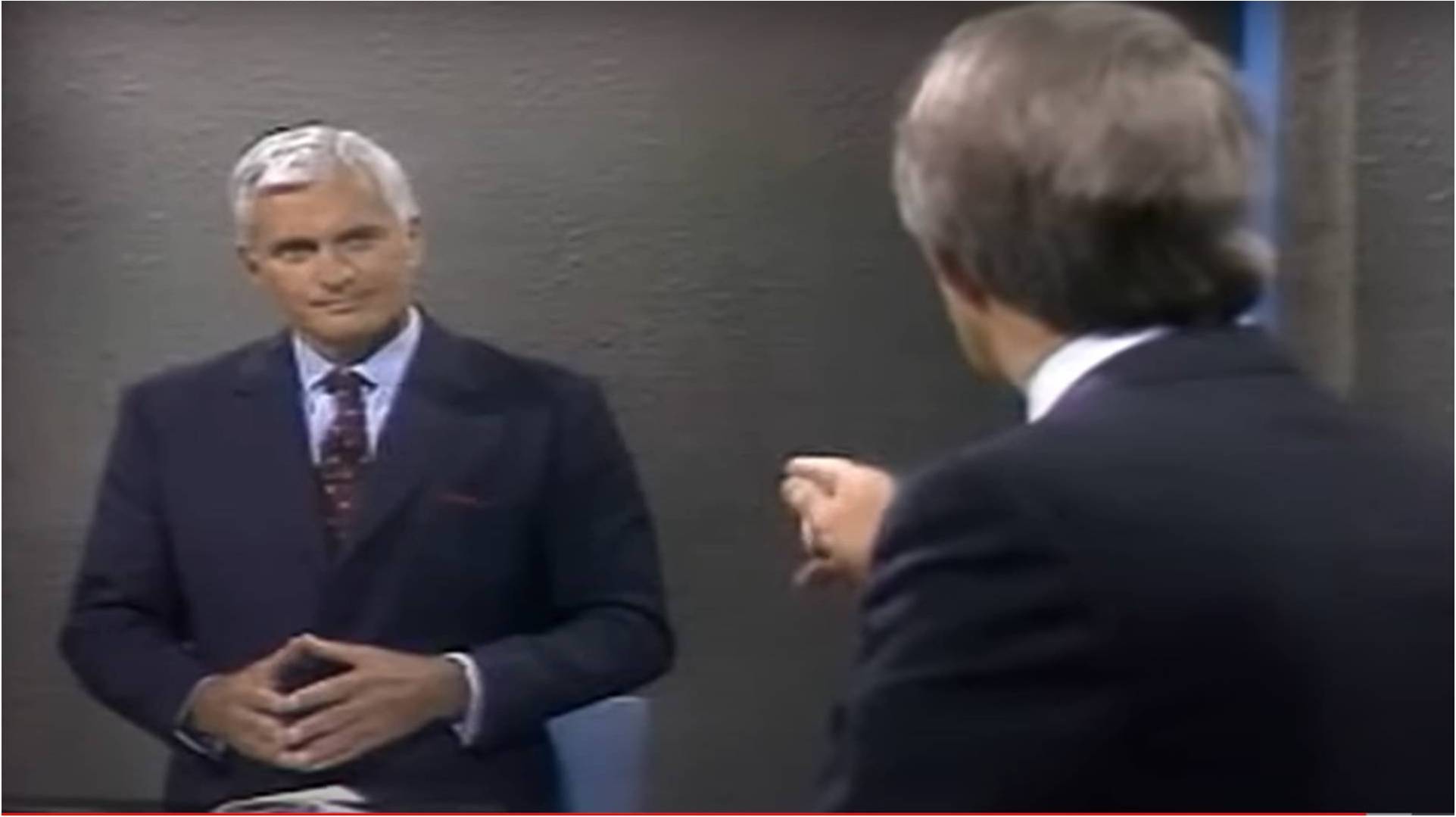
Mulroney unleashed his dramatic yet so typically Canadian-sounding flourish, “You had an option, sir!” which has become the only part of this 90-minute debate that anyone remembers at 1:36.44. But Mulroney did not conjure up the sentiment or even the form of “having an option” from nothing. In fact, the journalists on the panel prompted Turner and Mulroney to parry several times on the question of Trudeau’s outgoing patronage, first at around the 20-minute mark. These sections are worth watching or reading in full.
At 20:42, Bruce Phillips, the Ottawa Bureau Chief of CTV News, asked Prime Minister Turner about Pierre Trudeau’s outgoing patronage appointments.
“It’s back to those wretched patronage uh appointments, Mr. Turner, I’m afraid. We here didn’t think your answer last night on the French debate got to the basic issue which was the quality of your judgment in that particular case. You said you didn’t want to make those appointments, you didn’t think they were very good ones, but that Mr. Trudeau had held a gun to your head. Some conversational [sic, constitutional?] experts now say the gun didn’t have any bullets in it, but we’ll put that aside. Why didn’t you, Mr. Turner, tell Mr. Trudeau that if he wanted to go down in history as the man who sabotaged the party that had given his trust for 16 years, he was quite free to do that, but you were not going to stain your Administration on the very first day of its life by agreeing to an unsavory bargain? We got the impression from all of this that the very first time you were confronted with a choice between doing what you felt in your heart to be right and what was politically expedient you chose expedience.”
John Turner responded at 21:37:
“I’m going to say to you as I said throughout the past two weeks that Mr. Trudeau had every right and privilege as prime minister of this country to make all of these appointments before he resigned. And he was prepared to do so. And he spoke to the caucus to that effect. Now, that would have placed me in a minority position, having a minority of seats in the House, and the advice I got – and there may be contrary advice that’s available – but the advice I received, and I had the job and I had the evaluation to make, is that if that were to happen, the governor general could have refused me the responsibility of forming government. Now, that happens to be a fact. So I’m saying to you that I had no option.”
John Turner seemed to be suggesting here that all Trudeau’s patronage appointments of various cabinet ministers and MPs to other plum postings would have reduced the Liberals’ majority in the House of Commons to a plurality and would therefore have opened the possibility for Osbaldeston’s “extreme case” that Governor General Jeanne Sauvé would have refused to appoint him as the next Prime Minister of Canada. But this was false, and Bruce Philips intervened to say as much at 23:31:
“Mr. Moderator, just may I make one very brief point of clarification on this very issue? You still would have had the largest number of seats in the House, the normal basis on which a party leader is asked to form a government. Were you given any indication by the Governor General or anybody in Government House that you would not be called upon to form a government?”
Turner replied at 23:49, though did not answer whether he had heard anything from Governor General Sauvé herself or the Office of the Governor General but simply reiterated that he accepted Osbaldeston’s advice:
“That was the that was the opinion and the understanding that that I received, right. And I’m telling you frankly – I’m telling the Canadian people frankly – that I had no option and I’m saying this, I’m saying this to Canadians, and I’m not I’m not telling uh one story to members of my party and another story to the people of Canada. That is the situation the way I found it and I tell you, sir, I had no option.”
Brian Mulroney, leader of the Progressive-Conservative Party, encouraged Turner to publish his “secret letter” to Trudeau regarding patronage appointments at 1:22.11:
“You, sir, have raised this patronage to new to new heights. You have done something that’s never been done before: appointing 19 liberal members of parliament on the last second in a secret deal with a letter that you have yet to produce to the Canadian people […]. You took a secret Arrangement and you honored it on behalf of a political party I think to the detriment of Canada.”
Mulroney told Turner: “[..] please produce the secret letter that you signed that you undertook to make these appointments […].”[45] At 1:36.39 and 1:37.18, Turner looked as if he had at some point in June been held hostage and seemed utterly convinced on this falsehood and nonsense that Governor General Sauvé would not have appointed him as Prime Minister if he had not pledged in writing to Trudeau to allow the patronage appointments to stand:
1:36.39: “I’ve told you and told the Canadian people, Mr. Mulroney, that I had no option.”
1:37:18: “I’ve taken the Canadian people through the circumstances. Mr. Trudeau had every right to make those appointments before he resigned. In order that he not do so, yes, I had to make a commitment to him; otherwise I was advised that with serious consequences to the Canadian people, I could not have been granted the opportunity of forming a government.”[46]
An Amusing Interview with a Glaswegian Journalist in British Columbia
The following month, Turner recorded an interview with Jack Webster, a swaggering Glaswegian journalist based in Vancouver, which aired on 27 August 1984. Turner laid out once more the background on the patronage appointments.[47] The relevant portions of the interview runs from 4:38 to 8:14, and I’ve deciphered Webster’s sometimes unintelligible Glaswegian brogue as best I can.
Turner: “I made an undertaking to the Prime Minister [Pierre Trudeau]. He could have made all those appointments himself. I operated on the basis of the facts I had at the time, Jack. I operated on the basis of the advice I received at the time. I completed some of those appointments in order to preserve a majority in the House of Commons. […]
Webster: “But with hindsight, do now confess or admit that it was a mistake to sign that secret deal with Trudeau […]?”
Turner: “Well, there’s no doubt about it that the Prime Minister went to caucus before I was sworn in and told the caucus that he would get an undertaking from me, and if he didn’t, he would make those appointments.”
Webster seemed incredulous that the Governor General could even have asked Brian Mulroney to form a government in June 1984. He also suspected (probably correctly) that Trudeau had set Turner up to fail and that Trudeau had originally given him this disastrous advice.
Webster: “Let me get this clear, sir. Are you telling me that Trudeau, had he appointed these MPs – 17 or 19, whatever it was – by himself, that you might not have been able to form a government at that juncture? Is that what you’re telling me? That the Governor General might have sent for Mulroney?”
Turner: “That is right, sir.”
Webster: “Was this Trudeau’s advice to you?”
Turner: “This was the advice I got from the Clerk of the Privy Council and from the Department of Justice and from some others.”
Webster: “So that was why you signed the deal?”
Turner: “That was the only way that I could have a whole list of options as to whether to form a government, to whether to call an election or not call an election. And as I say, Mr. Trudeau had the ultimate discretion himself as Prime Minister to make all those appointments that he wanted.” […]
Webster: “Will you release the Trudeau-Turner Letter?”
Turner: “I like that I think that that is a letter between two to prime ministers, and the custom is that that remain in confidence.”
Turner hinted that he did not like the arrangement (Trudeau “had the ultimate discretion […] to make all those appointments that he wanted”) and also identified Osbaldeston by his title as the source of the advice – despite having earlier been warned against invoking either name.
Trudeau’s Motive and the Internecine Warfare with the Liberal Party of Canada
The Rivalry Between Pierre Trudeau and John Turner
Trudeau sabotaged Turner’s leadership and premiership because the bad blood between them extended back to at least 9 September 1975, when Turner resigned as Minister of Finance. At the time, neither Turner nor Trudeau admitted publicly to any serious policy disagreement between them and both spoke courteously of each other, but they in fact differed in how the Government of Canada should have solved the stagflation (high inflation combined with high unemployment) of the 1970s.[48] During the campaign for the Liberal leadership on 10 May 1984, Turner indiscreetly told journalists when he considered himself off the record that he had resigned as Minister of Finance in 1975 because Trudeau did not support his policies. Thomas Walkom of The Globe and Mail reported on 11 May: “John Turner has finally shed some light on his abrupt departure from the federal Cabinet in 1975, accusing Prime Minister Pierre Trudeau of failing to support his attempts to negotiate voluntary wage curbs.”[49] According to Canadian historian Paul Litt, “Trudeau’s long-standing resentment of Turner exploded in anger.”[50] Trudeau took the unprecedented decision to intervene in the Liberal leadership race, and his press release refuting Turner’s remarks as a retroactive “misrepresentation of events” made the front page of The Globe and Mail on 12 May.[51]
On 16 June 1984, Turner won the Liberal leadership on the second ballot with 54% of the vote versus 40% for Jean Chretien in became a mere pyrrhic victory. Trudeau refused to give Turner the customary political endorsement where the outgoing and incoming leaders stand together on the stage and raise their hands in unison to symbolize continuity and cohesion; instead, Trudeau stood behind Turner and Chretien in an subtle but unmistakable gesture of disapproval.[52] Pierre Trudeau argued upon the publication of his memoirs in 1993 that historians had mistakenly and “unfairly blamed” him for the patronage scandal in 1984. The Globe and Mail reported:
Mr. Turner was offered a simple choice: Mr. Trudeau could make the appointments himself, or Mr. Turner could do it later on his behalf, the former prime minister told a Halifax news conference. Mr. Trudeau recounted a conversation he had with Mr. Turner in June of 1984.
“I said, ‘Well, John, you’re the leader now. Do I name these 15-20 people now or do you want to do them for me after I’ve left Parliament?’ And he thought about it, and he said, ‘Well, I’ll do them for you.’”[53]
Trudeau does, in fact, deserve at least some blame for having first suggested to the leadership candidates at the aforesaid meeting in April 1984 that whoever succeeded him could finish making his appointments, and for having sabotaged Turner in other ways. Ironically, Trudeau devoted no space in his autobiography to the Liberal leadership convention of 1984, nor anything on the transfer of power to Turner, nor on Turner’s brief tenure as prime minister, nor even to the election of 1984. Trudeau ended the chapter “Welcome to the 1980s” with an account of his “long walk in the snow” of February 1984 and then skipped straight to “Life After Politics”.[54]
Jean Chretien never accepted his loss to John Turner in 1984 and spent the next few years undermining Turner until eventually capturing the Liberal leadership himself in 1990. He believed that his second-place showing at the Liberal leadership convention in 1984 entitled him to extort Turner into naming him Quebec Lieutenant over André Ouellet, the Labour Minister under Trudeau’s cabinet who strongly supported Turner.[55] The Globe and Mail reported that as late as 28 June (two days before the Governor General appointed Turner as Prime Minister), “Mr. Turner and Mr. Chretien remained locked in a stand off over the role that Mr. Chretien would play in the next federal cabinet.”[56] The Globe and Mail also reported that Turner and Chretien met for an hour on the morning of 27 June but failed to resolve their dispute about who would become the Quebec Lieutenant.[57] Chretien demanded that Turner make him Quebec Lieutenant; Turner refused and instead formally abolished the role altogether.[58]
Jean Chretien Similarly Undermined Paul Martin
The rivalry between Pierre Trudeau and John Turner and that between Jean Chretien and John Turner in the 1980s carried over to Jean Chretien and Paul Martin from 1990 to 2003. These tensions in some ways form part of the same broader conflict within the Liberal Party between the English and right wings on the one hand and the French and left wings on the other. Chretien undermined Martin in the intra-party, mid-parliamentary transfer of power between their ministries in 2003 just as Trudeau undermined Turner throughout the leadership convention and the intra-party, mid-parliamentary transfer of power between their ministries in 1984.
Jean Chretien recounts in his political memoir that he still “intend[ed] to follow the schedule that [he] had announced in Chicoutimi and to remain prime minister until February 2004.” Otherwise, “if [he] resigned as soon as [his] successor was chosen, it would be hard for him to call an election during the depths of winter.”[59] Here Chretien referred to his announcement on 22 August 2002 at the Liberal parliamentary party’s retreat in Chicoutimi that he would resign as leader of the Liberal Party and Prime Minister in early 2004.[60] Chretien wanted to follow his original timeline and carry out his Long Goodbye before finally resigning in February 2004 because he believed that the Liberal Party would hold its leadership convention around the same time as well; however, “the Martinites had become so anxious to measure the drapes in the PMO and ride in a limousine that they got the party executive to bring the leadership convention forward to November 2003.”[61] According to Chretien, Martin had originally agreed to this bizarre arrangement where he would become leader of the Liberal Party in 2003 while Chretien would remain as Prime Minister until 2004 but then abruptly changed his mind. Chretien declared: “‘Okay by me. If that’s what he wants, that’s what he’ll get.’ […] Not waiting until February would prove to be a fatal error in judgement on Martin’s part.”[62]
Paul Martin recounts the tale a bit differently in his memoir. According to Martin, he had accepted Chretien’s plan to remain as Prime Minister until February 2004 but that Chretien later altered the agreement:
Soon after I was chosen as leader, however, word reached us that the prime minister was actually planning to step down much sooner. At one time, this would have been welcome, but at this date it complicated our transition plans. We then got indication that he [Chretien] would stay on his original date only if we asked him to, something that would have seemed laughable after we had had so long to prepare for office.[63]
Martin believes that Chretien advised Governor General Adrienne Clarkson to prorogue the previous session of parliament in November 2003 to prevent the Auditor General from tabling her report into what became the Sponsorship Scandal until after he had left office in 2004; consequently, writes an embittered Martin, Chretien deliberately sabotaged his premiership before it had begun: “the prime minister [Chretien] had already guaranteed that the report, which dealt with problems on his watch, would only be released on mine.”[64] Martin concludes:
The idea that having relinquished the leadership of the Liberal Party, but not yet the office of prime minister, Jean Chretien would summon Parliament into a new session in early 2004, have a throne speech, table the Auditor General’s report, take the heat that was rightfully his, and then – at that point and that point only – hand over the Prime Minister’s Office is too absurd to take seriously. The fact is Jean Chretien could easily have chosen to have the Auditor General’s report tabled and made public while he was prime minister – but he opted not to do so.[65]
Trudeau similarly outfoxed Turner, took advantage of his impatience to become prime minister and ignorance of constitutional conventions, and sabotaged his doomed premiership from the outset through a clever ploy and bluff. In both cases, the two sets of Liberal leaders involved loathed one another.
Conclusion: “Canada’s Kennedy” Could Not Live Up To His Own Myth
The constitutional precedents up to 1984, as well as the public statements of Ed Broadbent and Brian Mulroney, clearly pointed toward only one plausible and reasonable outcome: Governor General Jeanne Sauvé would have commissioned John Turner to form the 23rd Ministry on 30 June 1984 even if Pierre Trudeau had appointed up to 23 Liberal MPs himself and reduced the Liberals to a plurality 15 short of a majority in the House Commons. After all, Governor General Roland Michener first appointed Pierre Trudeau as Prime Minister and head of the 20th Ministry on 20 April 1968 when the Liberals only held a plurality in the House of Commons, and no one believed that he should have done otherwise. Turner simply did not understand the constitutional conventions of Responsible Government – despite having served as an MP throughout a series of minority parliaments in the 1960s and 1970s and in both Pearson’s and Trudeau’s ministries in 1968 – or else he would have summarily dismissed Trudeau’s bluff and Osbaldeston’s preposterous advice and refused to sign an obsequious secret letter pledging to finish undertaking all Trudeau’s outgoing appointments. Turner could not differentiate good and reasonable advice from wild hypothetical speculation. However, some blame also rests with Osbaldeston who should have known better. Constitutional conventions in Canada and other Commonwealth Realms rely, above all, on practicality.[66] And the “extreme case” that Osbaldeston raised was, quite simply, impractical and so improbable that it did not merit mention apart from in a footnote because neither Brian Mulroney nor Ed Broadbent had ever made any public statements which made the extreme case the least bit plausible. Osbaldeston failed as the Clerk of the Privy Council to provide John Turner sensible and reasonable constitutional advice and muddled the entire purpose of the constitutional conventions by which Governors General appoint Prime Ministers with the most preposterous hypothetical. He led Turner astray.
Yet Turner’s poor judgement in trusting Trudeau’s musings and Osbaldeston’s official advice somehow fit with his other stumbles and mistakes throughout 1984. Turner came across as a paradoxically stilted yet overly presumptuous Don Draper-like timecapsule of the early 1960s. He infamously justified calling grown women “girls” and condescendingly patting their posteriors, saying: “I’m a tactile politician.”[67] He even boldly told reporters: “I don’t think that they [women] find it [being patted on the behind] offensive at all”[68] and doubled-down on his Mad Men method during the English-language leaders’ debate, referring to touching women’s posteriors as “a mark of friendship” and a gesture “which meant no disrespect.”[69] Even in the 1980s, Turner’s jocular persona struck most voters as an off-putting relic of the social mores from some twenty years earlier. Turner’s awkward anachronistic performance throughout 1984 revealed a painful truth: he had failed to live up to his own myth.
The Canadian media had tried to portray John Turner as early as 1962 as “Canada’s [Jack] Kennedy”: a well-educated, handsome former Rhodes Scholar who danced with Princess Margaret and added both a touch of glamour and romanticism to the dreary tedium of Mackenzie King, Louis St. Laurent, and Lester Pearson as well as a steady hand in contrast to the erratic and mercurial John Diefenbaker[70]; in reality, Pierre Trudeau had stolen that mantle from Turner by 1968, and Turner simply could not live up to his own false image. Turner seemed oblivious to something as simple as how the public perceived his boorish and presumptuous tactility – and ironic lack of tact. He has gone down in Canadian political history as a caricature and the victim of the greatest exchange in any leaders’ debate, as well as one of the many politicians (along with Joe Clark, Kim Campbell, Paul Martin, and Gordon Brown) who seemed better at being a cabinet minister than prime minister.
Turner’s confounding ignorance toward the constitutional conventions of Responsible Government and astounding gullibility to Trudeau’s bluff and Osbaldeston’s corroborating wild speculation sabotaged his premiership, and he turned himself into the patronage patsy. This merits some historical recognition as well, if only as a cautionary tale and frame of reference to explain the true constitutional conventions by which Governors General appoint Prime Ministers in Canada. This bizarre and obscure precedent should stand alongside the Double Shuffle of 1858, Macdonald’s tactical prorogation of 1873, Aberdeen’s dismissal of Tupper in 1896, Minto’s near-dismissal of Laurier in 1900, the King-Byng Thing of 1926 (which continues to resonate a century later because perhaps the name of the precedent rhymes), and the tactical prorogations of Chretien in 2003, Harper in 2008 and 2009, and Trudeau II in 2020, all of which reveal the boundaries of the Prime Minister’s authority and the Governor General’s discretion.
Similar Posts:
- The Caretaker Convention
- A Review of the Play 1979 and Joe Clark’s Legacy (May 2017). This contains some equally hilarious moments from the Leaders’ Debate of 1979, “Encounter ’79.”
- Why the Finance Minister Is Most Important After the Prime Minister (April 2017)
Notes
[1] Audrey O’Brien and Marc Bosc, “Appendix 12: General Election Results Since 1867 – 33rd Parliament,” in House of Commons Procedure and Practice, 2nd Edition (Ottawa: House of Commons of Canada, 2009), at page 1278; Lawrence LeDuc et al., “Table 9.4: Results of the 1984 Federal Election, by Province”, in Dynasties and Interludes: Past and Present in Canadian Electoral Politics (Toronto: Dundurn Press, 2010), at page 359.
[2] According to Peter C. Newman’s column first published in 1968, Liberal strategist and cabinet minister Jack Pickersgill referred to the Liberals as “The Government Party.” In 2011, Newman attributed a slightly different phrase to Pickersgill, who apparently referred to the Liberals as “the natural government party” (emphasis Newman’s), and Canadian politicos now often refer to the Liberals by the slightly different variant “the natural governing party” (my emphasis). Peter C. Newman, “Jack Pickersgill: ‘Sailor Jack’ and the Politics of Patronage,” 285-300 in Mavericks: Canadian Rebels, Renegades, and Anti-Heros (Harper-Collins Publishers Ltd, 2010), 288; Peter C. Newman, “Why the Grits Became the Natural Government Party,” chapter 6 in When the Gods Changed: The Death of Liberal Canada (Random House Canada, 2011), 80.
[3] Peter Mansbridge, “The Debate That Changed Debates,” Policy Magazine, September 2019.
[4] David J. Lanoue, “One That Made a Difference: Cognitive Consistency, Political Knowledge, and the 1980 Presidential Debate,” Public Opinion Quarterly 56, no. 2 (Summer 1992): 168-184.
[5] CBC Digital Archives, “1984: Trudeau Announces His Resignation,” 29 February 1984.
[6] The Globe and Mail, “Trudeau Resignation Sad Surprise for Party,” 22 November 1979, at page 10;
[7] O’Brien & Bosc, “Appendix 12: General Election Results Since 1867,” 1278; CBC Archives, “1979: Joe Clark’s Government Falls,” The National, 13 December 1979; House of Commons, Debates, 31st Parliament, 1st Session , 13 December 1979, at 2362; Jeffrey Simpson, “Liberal MPs Unanimous in Wanting Trudeau to Lead,” The Globe and Mail, 15 December 1979; Paul Palango, “The Winter Campaign: Trudeau’s Return Pleases All Sides in Metro Ridings,” The Globe and Mail, 19 December 1979, at page 10.
[8] O’Brien & Bosc, “Appendix 12: General Election Results Since 1867,” 1278.
[9] House of Commons Debates, 32nd Parliament, 2nd Session, 33 Elizabeth II, Volume IV, 1984, “Message from the Senate: The Royal Assent,” 29 June 1984, at page 5345. The Speaker noted that the “this House stands adjourned until Monday, September 10, 1984, at eleven o’clock a.m.” Privy Council Office, “Twenty-Second Ministry, 3 March 1980 – 29 June 1984” in Guide to Canadian Ministries Since Confederation (Ottawa: Queen’s Printer, 31 April 2017); Privy Council Office, “Twenty-Third Ministry, 30 June 1984 – 16 September 1984” in Guide to Canadian Ministries Since Confederation (Ottawa: Queen’s Printer, 31 April 2017). Turner resigned on 16 September 1984 after serving only 78 days as Prime Minister of Canada. The Privy Council Office at some point in the late 2010s decided to change its methodology in the online version of the Guide to Canadian Ministries Since Confederation, which now records the end of the previous ministry as its last full day in office, even though in most cases the Governor General accepted the resignation of the outgoing prime minister and formally commissioned the prime minister-designate on the same day. So in reality, Pierre Trudeau formally tendered his resignation to Jeanne Sauvé on 30 June, and Sauvé then swore in John Turner about 30 minutes later – as the newspapers made clear at the time – on 30 June. Yet the Guide to Canadian Ministries Since Confederation now lists Trudeau’s last day in office as 29 June because that was his last full day in office. Appendix 6 in House of Commons Procedure and Practice preserves the correct date and says that Sauvé accepted the resignation of Trudeau and the 22nd Ministry and swore in Turner at the head of the 23rd Ministry both on 30 June 1984. Audrey O’Brien and Marc Bosc, “Appendix 6: Government Ministries and Prime Ministers of Canada Since 1867,” in House of Commons Procedure and Practice, 2nd Edition (Ottawa: House of Commons of Canada, 2009), at page 1252.
[10] Terry Hargreaves, “Patronage on the Installment Plan,” Maclean’s, 9 July 1984, at page 9.
[11] Stevie Cameron, “Trudeau Rewarded 225 in 30 Days,” The Ottawa Citizen, 6 July 1984, at page 1.
[12] Hargreaves, “Patronage on the Installment Plan,” at page 9; The Globe and Mail, “Plums Doled Out to Liberal Caucus,” 10 July 1984, at page 4; The Globe and Mail, “MacEachen Departure Opens Door: Turner, Chretien at Standoff,” 28 June 1984, at pages 1 & 5. To the Senate, Trudeau nominated Joyce Fairbairn (his Legislative Assistant from 1970 to 1984), and Colin Kenney (his former policy advisor). In addition, he doled out a plum diplomatic posting to Ruth Derrick (one of his legislative assistants) as the Consul General in Boston. He also named Marie-Andrée Bastien (his director of correspondence) as the Executive Vice-President of the Canadian Sports Pool Corporation, Edward Johnson (his executive assistant) as a director at De Havilland Aircraft, Jeffrey Goodman (his former special assistant and Director of Public Relations at RJR-MacDonald Inc) to the National Advisory Council on Fitness and Amateur Sport, and Robert Pace (a special assistant in his PMO) as the Director of the Export Development Corporation.
[13] Hargreaves, “Patronage on the Installment Plan,” at page 9.
[14] Hargreaves, “Patronage on the Installment Plan,” at page 9.
[15] Hargreaves, “Patronage on the Installment Plan,” at page 9.
[16] The Globe and Mail, “Plums Doled Out to Liberal Caucus,” 10 July 1984, at page 4.
[17] On 9 July 1984, Governor General Sauvé issued the trio of proclamations dissolving the 32nd Parliament, issuing the writs of election for a polling day on 4 September, with the writs returnable and summoning the 1st session of the 33rd Parliament for 24 September 1984. The Prime Minister advised the Governor General on the first and third by instrument of advice, while cabinet issues the operative advice for the second by order-in-council. House of Commons of Canada, Journals, 32nd Parliament, 2nd Session, 1983-1984, Volume 127, “‘Proclamation’ Dissolving Parliament,” at page 717; House of Commons of Canada, Journals, 33rd Parliament, 1st Session, 1984-1985-1986, Volume 128, “‘Proclamations’ Issuing the Writs of Election and Summoning the Next Parliament,” at page v.
[18] The Globe and Mail, “Plums Doled Out to Liberal Caucus,” 10 July 1984, at page 4.
[19] The Globe and Mail, “Plums Doled Out to Liberal Caucus,” 10 July 1984, at page 4. Eymard Corbin (MP for Madawaska—Victoria), Thomas Henri Lefebvre (MP for Pontiac—Gatineau—Labelle), Claude Lajoie (MP for Trois-Rivières), as the Gentleman Usher of the Black Rod, and Charles Turner (MP for London East).
[20] The Globe and Mail, “Plums Doled Out to Liberal Caucus,” 10 July 1984, at page 4. Paul Cosgrove (MP for York—Scarborough) became a Judge of the Ontario County Court; Bud Cullen (MP for Sarnia—Lambton) became a Judge of the Federal Court of Canada (Trial Division); Robert Daudlin (MP for Essex-Kent) became a Judge of the Ontario County Court; and Rosaire Gendron (MP for Kamouraska—Rivière-du-Loup) became a Citizenship Judge.
[21] The Globe and Mail, “Plums Doled Out to Liberal Caucus,” 10 July 1984, at page 4. Maurice Dupras (MP for Labelle) became the Consul-General in Bordeaux, France; Bryce Mackasey (Liberal MP for Lincoln) became Canada’s Ambassador to Portugal; and Eugene Whelan (Minister of Agriculture) became Ambassador and Permanent Representative of Canada to the United Nations Food and Agriculture Organisation in Rome.
[22] The Globe and Mail, “Plums Doled Out to Liberal Caucus,” 10 July 1984, at page 4. Rod Blaker (MP for Lachine) became a Member of the National Parole Board; Denis Ethier (MP for Glengarry—Prescott—Russell) became Chairman of the Livestock Feed Board; Paul McRae (MP for Thunder Bay—Atikokan) became the Commissioner of the Canadian Radio-Television and Telecommunications Commission; Arthur Portelance (MP for Gamelin) became a member of the Canadian Aviation Safety Board; Mike Landers (MP for Saint John) became the Canadian Transport Commissioner; and Gérald Laniel (MP for Beauharnois—Salaberry) became a member of the S. Lawrence Seaway Authority.
[23] The Globe and Mail, “Plums Doled Out to Liberal Caucus,” 10 July 1984, at page 4. Léonce Mercier, a Liberal official and Chrétien loyalist, became a Citizenship Judge, while Charles Bédard was named as Canada’s Consul-General in Strasbourg.
[24] Thomas Walkom, “Trudeau Ready for Last Dip into Patronage Pot,” The Globe and Mail, 22 June 1984, at page 5.
[25] Greg Weston, “Anatomy of Defeat: The Inside Story Indicts Turner for Bad Judgement,” The Ottawa Citizen, 5 September 1984, at page 9.
[26] John Turner, interview with Jack Webster, Webster!, 27 August 1984, accessed 22 February 2024 from the YouTube Channel of B.C. Archives < https://www.youtube.com/watch?v=wi0nkC1zJpI&t=181s>
[27] The Ottawa Citizen, “Clark Prepares Speech for UN, Gives No Hint on Mackasey Post,” 19 September 1984, at page A4.
[28] House of Commons of Canada, Journals, 32nd Parliament, 2nd Session, 1983-1984, Volume 127, “‘Proclamation’ Dissolving Parliament,” at page 717; House of Commons of Canada, Journals, 33rd Parliament, 1st Session, 1984-1985-1986, Volume 128, “‘Proclamations’ Issuing the Writs of Election and Summoning the Next Parliament,” at page v.
[29] O’Brien & Bosc, “Appendix 12: General Election Results Since 1867,” 1278; Lawrence LeDuc et al., “Table 9.4: Results of the 1984 Federal Election, by Province”, in Dynasties and Interludes: Past and Present in Canadian Electoral Politics (Toronto: Dundurn Press, 2010), at page 359.
[30] Privy Council Office, “Twenty-Fourth Ministry, 17 September 1984 – 24 June 1993,” in Guide to Canadian Ministries Since Confederation (Ottawa: Queen’s Printer, 25 September 2023).
[31] House of Commons of Canada, Journals, 33rd Parliament, 1st Session, 1984-1985-1986, Volume 128, “‘Proclamation’ Postponing the Summoning of the Next Parliament,” at page vii.
[32] Paul Litt, Elusive Destiny: The Political Vocation of John Napier Turner (University of British Columbia Press, 2011), 255; Greg Weston, “‘I Had No Option,’” chapter 1 in Reign of Error: The Inside Story of John Turner’s Troubled Leadership, 1-14 (McGraw-Hill Ryerson, 1988), 2.
[33] Weston, Reign of Error, 2.
[34] Weston, Reign of Error 4.
[35] Weston, Reign of Error 2.
[36] Charles Lynch, “Trudeau Appointments Hurt Turner the Most,” The Ottawa Citizen, 4 September 1984, at page 4. “I would not put it past Davey to have suggested to Trudeau that he get a commitment in writing from Turner that the patronage appointments would be made. After all, there was a time when Senator Davey was advisor to Prime Minister Pearson, and Pearson suggested to Trudeau, when he passed him he prime ministership in 1968, that there were some appointments he would like to see made. Trudeau turned his back on Pearson from the moment he was in power, and the appointments were not made.”
[37] Litt, Elusive Destiny, 258-259.
[38] Litt, Elusive Destiny, 259.
[39] Pierre Elliott Trudeau, Memoirs (Toronto: McClelland & Stewart, 1993), 272-273.
[40] Weston, Reign of Error, 5. Here Turner might have used that familiar name “Willy King” because he and William Lyon Mackenzie King both lived in the neighbourhood of Sandy Hill in Ottawa in the 1930s and 1940s and sometimes bumped into one another while walking their respective dogs. Turner therefore talked to King and might have felt as if he had known him. Paul Litt, Elusive Destiny: The Political Vocation of John Napier Turner (University of British Columbia Press, 2011), 14; Peter C. Newman, When the Gods Changed: The Death of Liberal Canada (Random House Canada, 2011), 78.
[41] F.C. Mears, “Promise Is Given to Refrain from Making Appointments,” The Globe, 4 November 1925; O’Brien & Bosc, “Appendix 12: General Election Results Since 1867,” 1274.
[42] Litt, Elusive Destiny, 259-260.
[43] Litt, Elusive Destiny, 260.
[44] Turner, interview with Jack Webster, 27 August 1984; John Turner, “Leaders’ Debate: Encounter ’84,” broadcast on 25 July 1984, accessed on 20 February 2024,
< https://www.youtube.com/watch?v=Ydv3f4Qfd0E&t=5813s>, at 21:37.
[45] Ibid., at 1:36.09.
[46] Ibid., at 1:37:18.
[47] Turner, interview with Jack Webster, 27 August 1984. The relevant portions of the interview runs from 4:38 to 8:14.
[48] Robert Lewis & Ian Urquhart, “Canada: Moving to Correct the Drift,” Maclean’s, 6 October 1975, at page 26; Ian Urquhart, “Was Turner, in Truth, Pushed?” Maclean’s, 6 October 1975, at pages 26-28.
[49] Thomas Walkom, “Quit Cabinet Over Curbs: Turner,” The Globe and Mail, 11 May 1984, at page 3.
[50] Paul Litt, Elusive Destiny: The Political Vocation of John Napier Turner (University of British Columbia Press, 2011), 243.
[51] Jeffrey Simpson, “PM Attacks Turner View of Departure,” The Globe and Mail, 12 May 1984, at page 1.
[52] Litt, Elusive Destiny, 249.
[53] The Globe and Mail, “Trudeau Denies Patronage ‘Myth,’” 19 November 1984, at page A4.
[54] Trudeau, Memoirs, 342.
[55] Jeffrey Simpson, “Tough Bargaining,” The Globe and Mail, 21 June 1984, at page 6.
[56] The Globe and Mail, “MacEachen Departure Opens Door: Turner, Chretien at Standoff,” 28 June 1984, at pages 1 & 5.
[57] The Globe and Mail, “MacEachen Departure Opens Door,” 28, at pages 1 & 5.
[58] The Globe and Mail, “MacEachen Departure Opens Door,” 28, at pages 1 & 5.
[59] Jean Chretien, My Years as Prime Minister (Toronto: Alfred A. Knopf Canada, 2007), 399.
[60] CBC News Archives, “Jean Chretien’s Long Goodbye,” 22 August 2002; BBC News, “Canada’s PM
Sets Resignation Date,” 22 August 2002.
[61] Chretien, My Years as Prime, 399.
[62] Chretien, My Years as Prime, 400.
[63] Paul Martin, Hell or High Water: My Life In and Out of Politics (Toronto: McClelland and Stewart Ltd, 2008), 249 (emphasis added).
[64] Martin, Hell or High Water, 249-250.
[65] Martin, Hell or High Water, 250.
[66] Bowden, “The Origins of the Caretaker Convention,” 439-443.
[67] CBC Archives, “‘A Very Tactile Politician’,” 13 July 1984.
[68] CBC Archives, “‘A Very Tactile Politician’,” 13 July 1984.
[69] John Turner, “Leaders’ Debate: Encounter ’84,” broadcast on 25 July 1984, accessed on 20 February 2024 < https://www.youtube.com/watch?v=Ydv3f4Qfd0E&t=5813s>, at 28:29.
[70] CBC Archives, “Canada’s Kennedy,” 1962.

 James Bowden's Blog