

House of Commons Procedure and Practice states clearly that the House of Commons holds the prime minister and ministers to account for their actions and decisions:
“While there may be other purposes and ambitions involved in Question Period, its primary purpose must be the seeking of information from the government and calling the government to account for its actions.”
Consequently, MPs must ask questions “within the administrative responsibility of the government or of the individual Minister addressed.” Previous Speakers have already ruled that questions must pertain to the administrative responsibility of the Government of Canada, which precludes anything relating to what provincial governments do, or even to what the political party of the government has done on matters like election expenses.[1] Furthermore, allowing ministers to ask the opposition questions inverts the entire purpose and function of Question Period and cannot logically be permitted. House of Commons Procedure and Practice also acknowledges under the heading “Conduct of Question Period” that “Ministers do not ask oral questions, neither of other Ministers nor of private Members.”
The current Speaker of the House of Commons of the United Kingdom actively enforces these principles. I have criticised Speaker Hoyle over his refusal to enforce the rule that MPs refer to each other in the third person and reserve the second-person “you” for the Speaker, but he at least intervenes immediately when the Prime Minister tries to invert the purpose of Prime Minister’s Questions and asks Sir Keir Starmer, Leader of His Majesty’s Loyal Opposition and the Labour Party, when he would do or what he thinks about x or y policy.
On 17 November 2021, Speaker Hoyle refused to allow Prime Minister Boris Johnson to ask a question disguised as a declarative and to baffle the House of Commons.
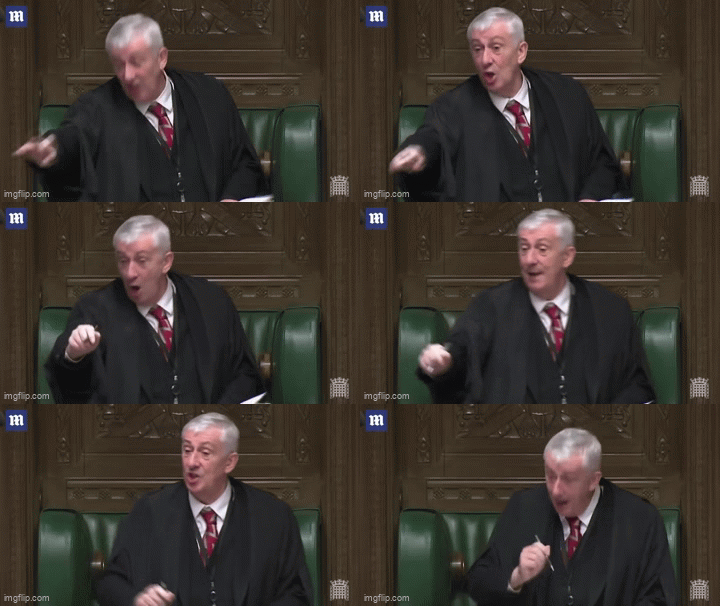
Keir Starmer: When somebody in my party misbehaves, I kick them out. When somebody in the Prime Minister’s party misbehaves, he tries to get them off the hook. I lead; he covers up. […]
If the Prime Minister votes for Labour’s motion this afternoon, that investigation can start. Will he vote for it, or will he vote for another cover-up?
The Prime Minister: I am very happy to publish all the details of the Randox contracts, which have been investigated by the National Audit Office already. But talking of cover-ups, I am sorry, Mr Speaker, but we still have not heard why the right hon. and learned Gentleman will not tell us—[Interruption.]
Mr Speaker: Order.
The Prime Minister: And he talks about—[Interruption.]
Mr Speaker: Order. Prime Minister, sit down! Prime Minister, I am not going to be challenged. You may be the Prime Minister of this country, but in this House I am in charge, and we are going to carry on. That is the end of that. I call Keir Starmer.
Keir Starmer: I think the Prime Minister just said he is happy to publish all the Randox papers in relation to these contracts, so we will take that and we will pursue it.[2]
On 10 May 2023, Hoyle leapt to his feet immediately and scolded Prime Minister Rishi Sunak twice, once for asking Sir Keir what he would do in a disguised declarative, and again for asking Sir Keir a question in a direct interrogative:
The Hansard recorded these exchange as follows:
The Prime Minister: I am sorry to hear of my hon. Friend’s constituent Gordon, and I send him my best wishes. He will now that transport in London is devolved to the Labour Mayor, who is expanding the zone against the overwhelming views of residents and businesses. What is more, his plan to raise costs for hard-working families is totally backed by the Leader of the Opposition. Perhaps he can now tell us why.
Mr Speaker: I do not think he [Sir Keir Starmer] is responsible for answering the questions. We come to the Leader of the Opposition.[3]
[…]
The Prime Minister: May I first put on record my thanks to the police for all their hard work over the weekend, ensuring that the coronation was a success? On this issue, we believe the police should have powers to make sure that they can protect the public from unnecessary and serious disruption. I respectfully recognise that the hon. Gentleman disagrees with our position. I guess the question for both of us is: what does the Leader of the Opposition think about this, because it is quite hard to keep up?
Mr Speaker: Order. Can I just remind the Prime Minister that this is Prime Minister’s questions? It is for him to answer, not for asking what the Opposition are doing.[4]
Speaker Hoyle once again told off Prime Minister Sunak on 25 October 2023 that the Prime Minister does not pose questions to the Leader of His Majesty’s Loyal Opposition.
The Prime Minister: […] so perhaps the Leader of the Opposition can explain to Annalisa and millions of others why when we brought forward plans to unlock 100,000 new homes, he stood in the way of that? [Interruption.]
Mr Speaker: Order. Just to say, it is Prime Minister’s questions, not Opposition’s questions. [Interruption.] I am sorry, Prime Minister; it is Prime Minister’s questions. I do not need you nodding against my decision.
Keir Starmer: I am sure that Annalisa and her children, who have now been evicted, will take great comfort from that non-answer[…].[5]
The Speaker of the House of Commons of Canada should make similar precedents here, not because the Speaker of the House of Commons of the United Kingdom has done so, but simply because allowing ministers to ask the opposition questions contradicts the entire purpose of our Question Period here in Canada, and because the current corpus of our speaker’s rulings here in Canada contains a gap in this area.
Speakers have refused to rule that ministers must answer the questions asked and declined to intercede on the relevance of answers provided by ministers. Andrew Scheer affirmed in September 2014 that he would not intercede in Question Period to force a minister to answer a question in any particular way,[6] and he cited two other precedents from 2010 where Peter Milliken issued the same ruling.[7]
But that is a slightly different matter from allowing ministers to ask the opposition questions, even when ministers cleverly cloak de facto interrogatives in disguised declarative statements like, “The Leader of the Opposition should explain what he thinks about x or y policies” or “The Leader of the Opposition should apologise for x or y thing.” The Leader of the Opposition should do no such thing because the Leader of the Opposition, by definition, does not take responsibility for the decisions made by the Government of Canada. The Leader of the Opposition, and all party leaders, would explain their policies during an election campaign.
A Speaker of the House of Commons of Canada could therefore rule that ministers cannot ask questions – whether as direct interrogatives or interrogatives disguised as declaratives – on three grounds: first and most fundamentally, that this notion undermines and makes a mockery of the entire purpose of Question Period, second, because House of Commons Procedure and Practice already recognises that ministers do not get to ask MPs questions, and third, and more perhaps more pedantically, allowing ministers to ask questions of the opposition violates the well-established principle, on which all speakers over the last thirty years have ruled consistently, that questions must pertain to the administrative responsibility of the ministers, who are not responsible for whatever another party does.
Any Speaker of the House of Commons of Canada who regards himself as The Disciplinarian should enforce the Standing Orders and precedent and decorum consistently against all MPs, and generally in a manner that upholds the capacity of the opposition to hold ministers to account, rather than in a way that undermines the official opposition.
Similar Posts:
- Parliament – Decorum
- Parliament – Speaker of the House of Commons
- When the Speaker Diffuses Tension with Humour: The “Choral Welcome” of October 27th, 2004 (May 2024)
- Anthony Rota Resigns in Disgrace as Speaker of the House of Commons (September 2023)
- Question Period and the “Administrative Responsibility” of Federal Ministers (November 2022)
- Orrrrrrddaaaaa! Speaking in the Second Person (January 2022)
- Suspending the Speaker of the Legislative Assembly of New Brunswick (April 2018)
Notes
[1] Gilbert Parent (Speaker), “Point of Order,” in House of Commons Debates, 36th Parliament, 2nd Session, volume 136, no. 066, Friday, 17 March 2000, at page 4825; Peter Milliken (Speaker), “Member for Calgary West,” in House of Commons Debates, 39th Parliament, 1st Session, volume 141, number 034, Tuesday, 6 June 2006, at page 2022; Peter Milliken (Speaker), “Elections Canada,” in House of Commons Debates, 39th Parliament, 1st Session, volume 142, number 005, Monday, 22 October 2007, at page 205; Peter Milliken (Speaker), “Member for Marc-Aurele-Fortin,” in House of Commons Debates, 40th Parliament, 3rd Session, volume 145, number 098, Wednesday, 17 November 2010, at page 6063; Andrew Scheer (Speaker), “Firearms Registry,” in House of Commons Debates, 41st Parliament, 1st Session, volume 146, number 056, Tuesday, 29 November 2011, at page 3741; Andrew Scheer (Speaker), “Oral Questions – Speaker’s Ruling,” in House of Commons Debates, 41st Parliament, 2nd Session, volume 147, number 036, Tuesday, 28 January 2014, at pages 2203, 2205.
[2] House of Commons Official Report, Parliamentary Debates (Hansard), Volume 703, No. 72, 17 November 2021, “Oral Answers: Prime Minister,” at page 572.
[3] House of Commons Official Report, Parliamentary Debates (Hansard), Volume 732, No. 157, Wednesday, 10 May 2023, “Oral Answers: Prime Minister,” at page 330.
[4] House of Commons Official Report, Parliamentary Debates (Hansard), Volume 732, No. 157, Wednesday, 10 May 2023, “Oral Answers: Prime Minister,” at page 332.
[5] House of Commons Official Report, Parliamentary Debates (Hansard), Volume 738, No. 212, 25 October 2023, “Oral Answers: Prime Minister,” at page 824.
[6] Andrew Scheer (Speaker), “Oral Questions: Statement by the Speaker,” in House of Commons Debates, 41st Parliament, 2nd Session, Volume 147, Number 115, Wednesday, 24 September 2014, at page 7771; House of Commons of Canada, Selected Decisions of Speaker Andrew Scheer, 2011-2015, The Daily Program, Daily Proceedings, Oral Questions: Relevance of Responses; Allegation of Bias, 24 September 2014.
[7] Peter Milliken (Speaker), “Points of Order: Oral Questions,” in House of Commons Debates, 40th Parliament, 3rd Session, Volume 145, Number 108, Wednesday, 1 December 2010, at page 6677. “It is not for the Chair to decide whether the content of a response is in fact an answer. As we have heard many times, that is why it is called question period not answer period. It is commonplace in the House. While I sympathize with the hon. member’s comments, and I know the government House leader might, too, in certain circumstances, it is not for the Chair to decide whether an answer or response given to a question constitutes an answer to that question. It is beyond the competence of the Chair to make that kind of decision under our practice.”

 James Bowden's Blog
Pingback: When The Speaker Admonishes the Prime Minister for Asking the Opposition Questions – Welcome to my page