
Wildfires Prompt a Special Sitting of the Legislative Assembly
In August 2023, the skies turned an ominous orange over large swathes of the Northwest Territories as gargantuan wildfires gobbled up forests and inched ever closer toward the edge of Yellowknife, forcing a mass-evacuation of the territories’ capital city.[1] Fires inherently pose a threat to human life and infrastructure, but these particular fires in 2023 have brought another unintended consequence: forcing a delay in the upcoming Northwest Territorian general election, scheduled for 3 October 2023 after a dissolution of the legislature on 3 September 2023.
Caroline Cochrane, the Premier of Northwest Territories, first raised the possibility of delaying the general election on 14 August. Glen Rutland, the Clerk of the Legislative Assembly, then told CBC News the following day that this “would require a legislative amendment” after obtaining the unanimous consent of the Legislative Assembly to fast-track such a bill.[2] If the legislature does not amend the Elections and Plebiscites Act to extend the life of the current 19th Assembly, then it will dissolve automatically by efflux of time on 3 September to accommodate the minimum writ period and the general election scheduled for 3 October.[3]
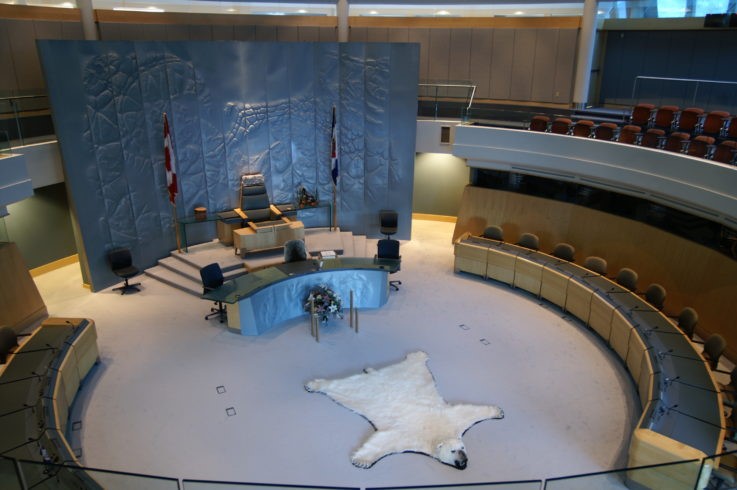
On 21 August, the Chief Electoral Officer and the Speaker of the Legislative Assembly issued a joint press release.[4] It says that Chief Electoral Officer Stephen Dunbar has recommended “that the Territorial General Election scheduled for October 3, 2023 be delayed until November due to the current wildfire situation in the Northwest Territories.” Speaker Frederick Blake Jr shared with the recommendation with caucus – meaning under the consensus government of Northwest Territories means all 19 MLAs – which indicated its “clear support for his recommendation.” The Speaker will recall the Legislative Assembly for Monday, 28 August so that MLAs can amend the Elections and Plebiscites Act to delay the general election until sometime in November 2023 instead of holding it on 3 October, as well as “to pass a supplementary appropriation” to cover the costs of fighting the forestfires and the evacuations. This emergency sitting will convene in Inuvik instead of Yellowknife. [5] The Speaker will then reconvene the Assembly in “late September” to continue the regular sittings of the 2nd session of the 19th Assembly. The press release concludes:
“As the Commissioner of the Northwest Territories, the Hon. Margaret Thom, has already ordered the CEO to issue writs of election in all 19 electoral districts on September 4, 2023, legislation must be passed to delay the election.
If legislation is not passed, the 19th Assembly will be dissolved on September 3, 2023. The Territorial General Election would proceed on October 3, 2023.
However, the Chief Electoral Officer has advised that he would need to withdraw the writ of election in any riding subject to an evacuation order. This would delay the election in that riding for a period of up to three months. This could result in Members being elected on different days between October and December 2023.”
What the Territorial Law Says on General Elections
Section 39(5) of the Northwest Territories’ Elections and Plebiscites Act contains the territory’s fixed-date elections law and schedules general elections for the first Monday in every fourth October, starting in 2007; subsequent scheduled elections occurred in October 2011, November 2015 under the 2015 Polling Day Act, and in October 2019:
“39 (5) Subject to the power of the Governor in Council under subsection 9(3) of the Northwest Territories Act (Canada) to dissolve the Legislative Assembly at any time after consultation, and to cause a new Legislative Assembly to be elected, polling day for a general election must be the first Monday in October in the fourth calendar year following polling day for the last general election.”[6]
The Commissioner of Northwest Territories, equivalent to the Lieutenant Governor of a province, also plays a role in issuing the writs the election:
“(2) The Commissioner shall, in an order referred to in subsection (1),
(a) direct the Chief Electoral Officer to issue a writ of election to the returning officer for each electoral district to which the order applies;
(b) fix the day on which the writ of election is to be issued;
(c) fix the day on which the poll must be held if a poll is required, which must not be earlier than the 29th day after the issue of the writ of election; and
(d) fix the day by which the writ of election must be returned.”[7]
This requirement flows from section 11(2) of the federal Northwest Territories Act.
“Writs
(2) Writs for the election of members of the Legislative Assembly are to be issued on the Commissioner’s instructions.”[8]
The requirement under section 11(2) that the Commissioner of Northwest Territories issues instructions on writs of election explains that bizarre reference in the joint press release of the Legislative Assembly and the Chief Electoral Officer of the Northwest Territories to how “the Commissioner of the Northwest Territories, the Hon. Margaret Thom, has already ordered the CEO to issue writs of election in all 19 electoral districts on September 4, 2023.”
This does not correspond to the normal practice in the provinces, the Chief Electoral Officers of which issue writs of election directly in accordance with the provincial Elections Act and advice from the Lieutenant Governor-in-Council and not on a separate instruction from the Lieutenant Governor. This might seem trivial but rests on an important distinction. Whenever a federal or provincial statute assigns something to the Governor-in-Council, this necessarily means that the Governor acts on advice from cabinet and not unilaterally or without an intermediate step. In addition, the Gazette would publish all such Orders-in-Council, executive instruments issued by the Governor-in-Council. But it seems that in Northwest Territories, when the federal Northwest Territories Act or territorial Elections and Plebiscites Act vests the Commissioner with the authority to order the Chief Electoral Officer to draw up writs, the Commission issues this instruction independently, and not on advice of the Premier, or the Executive Council, or the Legislative Assembly.
Premier Cochrane herself stated earlier this month that the general election should be delayed, so the Premier would presumably not have advised that Commissioner Thom order Chief Electoral Officer Dunbar to issue the writs in direct opposition to her own public statements. The wording of the joint statement released by the Chief Electoral Officer and the Speaker of the Legislative Assembly also sounds as if the Commissioner did not receive advice from the Legislative Assembly either. In 2019, the Northwest Territories Gazette does not record any statutory instruments or notices whereby the Commissioner instructed the Chief Electoral Officer to issue the writs for the previous general election, which suggests that the Commissioner instructs the Chief Electoral Officer to issue the writs on her own, without advice from either the Premier, Executive Council, or Legislative Assembly. In contrast, the Gazette from August 2019 includes a Dissolution Order issued under the authority of the federal Northwest Territories Act.[9]
Commissioner Thom has already ordered Chief Electoral Officer Dunbar to issue the writs, and the clock has already begun counting down: the website of Elections Northwest Territories now includes at the bottom of every webpage a notice on the “Territorial General Election: October 3rd, 2023,” 38 days away at the time of writing.[10]
CBC News asserted in mid-August that “if MLAs voted against formally delaying the election, it would go ahead as scheduled. […] In that event, Chief Electoral Officer Stephen Dunbar would delay the election in all evacuation zones for up to three months, which could mean MLAs could be elected at different times.”[11] Here CBC News alluded to section 42 of the Elections and Plebiscites Act but summarised it imprecisely. Section 42(1) states does not grant this authority to the Chief Electoral Officer alone but rather to the Chief Electoral Officer acting in concert with the territorial Commissioner:
“42. (1) The Commissioner may order the withdrawal of a writ of election for any electoral district for which the Chief Electoral Officer certifies that it is impracticable to carry out the provisions of this Act because of flood, fire or other disaster.
(2) The Chief Electoral Officer shall, without delay after an order withdrawing a writ of election is made under subsection (1),
(a) ensure that a notice of the withdrawal of the writ is published in the Northwest Territories Gazette; and
(b) forward a notice of the withdrawal of the writ to the returning officer for the electoral district […]
(4) If a writ of election is withdrawn under this section, an election must be instituted for the electoral district under subsection 39(1) within three months after the day of publication of the notice of withdrawal in the Northwest Territories Gazette.”[12]
The Canada Elections Act contains an equivalent authority (with the Governor-in-Council and Chief Electoral Officer also acting in tandem) for the withdrawal of writs “by reason of flood, fire or other disaster”.[13] I would argue that if the Legislative Assembly of the Northwest Territories fails to adopt a bill delaying the general election for whatever reason next week, the Chief Electoral Officer could certify that the fallout from the fires and the evacuations have made holding elections in all 19 electoral districts “impracticable” and that the Commissioner of Northwest Territories could therefore instruct the Chief Electoral Officer to withdraw all 19 writs and then select a new date sometime in November on which to hold the general election. However, I can also understand why this option is not optimal and that the legislature should enact a statute formally delaying the general election if possible. This scenario brings up uncomfortable comparisons to Newfoundland and Labrador’s pandemic election of 2021, in which Chief Electoral Officer Brian Chaulk unlawfully extended the writ because his province’s Elections Act contains no similar provision for withdrawing writs in an emergency.
Consensus Government In Contrast to Responsible Government
Consensus Government, a kind of consociational system which Northwest Territories pioneered in the late 1970s and which Nunavut inherited and continued in 1999, starts from the premise of non-partisanship. All MLAs are elected as independents because the electoral commissions and Legislative Assemblies of these territories do not recognise political parties in the first place, and the effects of this non-partisanship cascade through the system, namely on the authority of the Premier and Executive Councillors, and the nature of ministerial responsibility itself. The Commissioner must appoint as Premier the candidate whom the members of the Legislative Assembly themselves nominate in a practice akin to the confirmation voting which many European legislatures follow, including the devolved assemblies in Scotland and Wales. But Northwest Territories and Nunavut take confirmation voting one step farther: the Commissioner also appoints Executive Councillors in accordance with the Legislative Assembly’s advice. The Legislative Assembly can also at pleasure remove the Premier and Executive Councillors individually. The Premier can only assign portfolios to Executive Councillors. Non-partisanship in conjunction with confirmation voting for both the Premier and Executive Councillors mean that collective ministerial responsibility as we understand it in the rest of Canada does not exist and that Consensus Government relies on individual ministerial responsibility alone. The Premier does not control cabinet – the Legislative Assembly does.
The Legislative Assemblies of these two territories can table, and have tabled, motions of non-confidence in a Premier alone, or in one minister alone, or a handful of ministers at the same time but in separate line-items. In other words, Northwest Territories and Nunavut have abolished collective ministerial responsibility altogether because their Legislative Assembly and Executive Council Acts state clearly, and numerous precedents over the last thirty years affirm, that the tenure of the Premier does not determine the tenure of the ministry as a whole as it does in the provinces, Yukon, and Ottawa. For example, on 14 June 2018, the Legislative Assembly of Nunavut took the unprecedented step of ousting Paul Quassa as Premier and replacing him with Joe Saviktaaq, but this did not entail getting rid of the entire Executive Council.[14] On 31 October 2018, the Legislative Assembly of the Northwest Territories debated two separate motions on whether to revoke the appointments of two Executive Councillors and ultimately rejected both motions, all without raising any question of constitutional propriety.[15] In contrast, motions of non-confidence in the House of Commons and provincial legislative assemblies take the form, “That this House has lost confidence in the government,” and the entire Ministry stands or falls as one.[16] Speaker Milliken ruled against Nathan Cullen’s attempt in 2006 to table a motion of individual non-confidence in Rona Ambrose as Minister of the Environment. James Bezan tried to replicate that precedent by tabling a motion of non-confidence against Harjit Sajjan as a Minister of National Defence in 2017, but it died on the Order Paper in that majority parliament and obviated the need for the Speaker to issue a ruling affirming that of his predecessor.[17]
Even in the precedent from February 2009 where the Legislative Assembly debated a motion to oust the Premier and all Executive Councillors at once, the preambular clause did not use the standard form under Responsible Government “That this House has lost confidence in the government” – which implies collective responsibility – but instead said “That […] this Assembly formally revokes the pleasure of the Assembly from the appointments of the Premier and all Members of the Executive Council,” which at best inhabits a grey area between individual and collective ministerial responsibilities.[18] In any event, the motion was narrowly defeated 8 to 10.
Sections 61 to 69 of the Executive Council and Legislative Assembly Act of the Northwest Territories codify the basic precepts and procedures of Consensus Government. The Commissioner appoints the Premier and other Executive Councillors “on the recommendation of the Legislative Assembly”[19] and, “for greater certainty, the Premier chosen by the Legislative Assembly shall be appointed to the Executive Council by the Commissioner.”[20] Furthermore, “If a vacancy occurs in the office of Premier by death, resignation or otherwise, the Legislative Assembly shall choose another of its members to be Premier.”[21] The “otherwise” here affirms that the Legislative Assembly can oust a Premier in a want of confidence and advise the Commissioner to dismiss him or her from office.
Consensus Government has also definitively resolved the ambiguity which lingers in minority parliaments and legislatures elsewhere in Canada of precisely when the incumbent Premier resigns from office and whether he or she meets the new legislature and affirms that the incumbent Premier remains in office up until the moment when the next Legislative Assembly nominates another Premier: “The person who holds the office of Premier at the time of a dissolution of the Legislative Assembly continues to hold the office of Premier until the next Premier is chosen at the first sitting of the next Legislative Assembly.”[22] The same goes for incumbent Executive Councillors, who remain in office “until the beginning of the first day of sitting of the next Legislative Assembly, unless the person’s appointment or appointments are earlier revoked.”[23] The transfer of power between Premiers and Executive Councillors (but not ministries, since there is no collective responsibility) can thus only take place after the general election upon the next round of confirmation voting.
Unlike in Yukon, the provinces, and Ottawa, the Premier can only build a cabinet and assign portfolios from amongst these Executive Councillors whom the Commissioner appointed on the advice of the Assembly: “The Commissioner, on the advice of the Premier, may appoint under the Seal, from among the members of the Executive Council, the Ministers of the executive government.”[24] While the Premier can advise the Commissioner to “revoke an appointment of a member of the Executive Council as a Minister,” only the Legislative Assembly can remove an Executive Councillor. Crucially, therefore, section 3 of the statute also mandates that “The Commissioner shall convene the first session of a Legislative Assembly within 45 days after the day fixed for the return of the writs.”[25] The next provision also replicates section 5 of the Constitution Act, 1982 and stipulates that “The Legislative Assembly must sit at least once every 12 months.”[26]
Fixed-Date Election Laws Under Consensus Government
The federal and provincial fixed-date election laws have merely lowered the maximum life of the Parliament and legislatures from 5 years to something between 4 and 5 years. Automatic dissolution by efflux of time would therefore somewhere between every 4 and 5 years instead of every 5 years, but provincial premiers and federal prime ministers still prefer to offer the Lieutenant Governors and Governor General formal constitutional advice to dissolve the legislatures and parliament by proclamation in advance of the cut off where they would dissolve automatically by efflux of time pursuant to the fixed-date election laws. Section 4(1) of the Constitution Act, 1982 set the maximum life of the federal parliament and provincial legislatures at 5 years “from the date fixed for the return of the writs at a general election of its members”, and section 4(2) states that parliament or a legislature can pass a statute extending its life beyond that maximum of 5 years only “in time or real or apprehended war, invasion or insurrection” and if and only if a two-thirds super-majority in the House of Commons (but apparently not the Senate) or the legislative assembly votes in favour of the bill.
The Constitution Act, 1982 sets the maximum life of a parliament and legislature at five years, apart from those special circumstances, but remains silent on the minimum lifespan, which means that parliament or a legislature can shorten its maximum lifespan from 5 to 4 or whatever years under a normal statute, like a fixed-date elections law. However, only a constitutional amendment under the General Amending Procedure could increase its maximum lifespan beyond 5 years. The federal and provincial fixed-date election laws never established a minimum lifespan of provincial legislatures and federal parliaments, and they also all deliberately saved the authority of the Lieutenant Governors and Governor General to dissolve the legislatures and parliament under section 41(a) of the Constitution Act, 1982, which means that the premiers and prime minister can still advise the governors to dissolve legislatures and parliaments early at will.
But this section 4 probably only applies to the Parliament of Canada and the legislatures of the provinces, the only two orders of government entrenched in the Constitution of Canada. In contrast, municipalities remain creatures of the provinces, and thus subject to the control of provincial legislatures, and the territories remain creatures of Ottawa, and thus subject to the control of the Parliament of Canada. The Parliament of Canada extensively amended the Northwest Territories Act in 2014 to give the territory broad, province-like powers in conjunction with the Northwest Territories Land and Resources Devolution Agreement of June 2013.
The Northwest Territories Act of 2014 reconstituted the legislative power of the territory, renamed the “Council of the Northwest Territories”, and continued it as “The Legislative Assembly of the Northwest Territories.”[27] The statute also defines the Legislature of the Northwest Territories as the Commissioner and Legislative Assembly, in direct analogy to a provincial Crown-in-Parliament consisting of the Lieutenant Governor and the Legislative Assembly.[28] As part of the devolved territory’s broader province-like powers and status, the Parliament of Canada also increased the maximum lifespan of a legislative assembly from 4 to 5 years to match section 4(1) of the Constitution Act, 1982. Section 11 of the Northwest Territories Act now says:
“Duration
11 (1) No Legislative Assembly is to continue for longer than five years after the day on which the writs are returned for a general election, but the Commissioner may dissolve it before then.”[29]
This is good news. If Parliament had not amended the previous iteration of the Northwest Territories Act in 2014 and increased the maximum lifespan of a “Council” (as they were then known) from 4 to 5 years, then only the Parliament of Canada could have extended the life of the 19th Assembly by enacting a new statute.[30] If this emergency had happened in exactly the same way ten years earlier in 2013, the House of Commons and Senate would have to break off their summer recess and reconvene for an emergency sitting and quickly enact an amendment to the Northwest Territories Act.
The Northwest Territories Act post-2014 says that “the Commission may dissolve [the Legislative Assembly] before then,” or before five years have elapsed, which also mimics the equivalent wording in most provincial statutes, which allow the legislature to continue for x years “subject to being sooner dissolved by the Lieutenant Governor.” This also affirmed the authority of the Legislature of the Northwest Territories to lower the lifespan from 5 to 4 years under a territorial statute, in this case the Elections and Plebiscites Act.
Dissolution of the Legislature Under Consensus Government
Interestingly, however, the older version of the Northwest Territories Act pre-2014 also officially codified in federal a key tenet of Consensus Government which carried over in practice post-2014, even though the Legislative Assembly and Executive Council Act of Northwest Territories has not codified this specific aspect of Consensus Government in territorial law.
“9 (3) Every Council shall continue for four years from the date of the return of the writs for the general election and no longer, but the Governor in Council may at any time, after consultation with the Council where the Governor in Council deems consultation to be practicable or, otherwise, after consultation with each of the members of the Council with whom consultation can then be effected, dissolve the Council and cause a new Council to be elected.”[31]
Even though the legislature has chosen to codify the other key tenets of Consensus Government in the Legislative Assembly and Executive Council Act – such as confirmation voting for the Premier and Executive Councillors, and correspondingly, withdrawing confidence from individual Executive Councillors and the Premier[32] –, the legislature has not codified the de facto necessary requirement that Caucus (i.e., all 19 MLAs as a whole) would have to agree on an early dissolution, given that Caucus can always advise the Commissioner to dismiss a Premier and individual Executive Councillors from office. That Legislative Assembly can remove the Premier and any Executive Councillor at will makes early dissolution redundant in principle. As in European parliamentary systems, de facto constructive non-confidence and intra-parliamentary transfers of power usually obviate the need for early dissolution.
But in practice, early dissolution does not happen in Northwest Territories; general elections have occurred like clockwork every fourth October or November since the territory re-gained self-government in the 1970s.[33] The Legislative Assembly and Executive Council Act does, however, contain two references to a “Legislative Assembly […] ended by the passage of time”,[34] which refers to automatic dissolution by efflux of time under the Elections and Plebiscites Act once the legislature has reached its maximum lifespan. In addition, the official letters of instructions from the federal Minister of Indigenous and Northern Affairs to the Commissioner of Northwest Territories mandate that “With respect to proroguing sessions of the Legislative Assembly, and convening its future sessions, you will accept the Legislative Assembly’s advice.”[35] Logically and in principle, the same advice should apply on dissolving the Legislative Assembly as well.
And the record shows that this principle does indeed apply in practice. As provincial premiers and federal prime minister still prefer to advice the governors to dissolve legislatures and parliaments early by proclamation, the Legislative Assembly of Northwest Territories sometimes adopts motions advising the Commissioner to dissolve the legislature, even in advance of general elections held on the date scheduled under the Elections and Plebiscites Act. For instance, the 3rd session of the 18th Legislative Assembly adopted a motion on its last sitting day on 23 August 2019 advising the Commissioner to dissolve the legislature on 31 August 2019 for a general election on 1 October 2019.[36] The motion carried unanimously, with zero abstentions. More fascinating still, the Northwest Territories Gazette even published a Dissolution Order (2019) which confirms that the Commissioner dissolved the 18th Legislature directly on and in accordance with the advice of the Legislative Assembly:
“The Commissioner, on the recommendation of the Speaker and with the advice and consent of the Legislative Assembly, pursuant to subsection 11(1) of the Northwest Territories Act (Canada), orders that the Eighteenth Legislative Assembly is dissolved on August 31, 2019.”[37]
Here Consensus Government differentiates itself once more from Responsible Government. The equivalent executive instruments at the federal level consists of a trio of proclamations issued on the same day: first, the Governor General dissolves one parliament on the advice of the Prime Minister alone; second, the Governor General-in-Council issues writs of general election on the advice of cabinet; and third, the Governor General summons the first session of the new parliament pro forma on the advice of the Prime Minister.[38]
In previous years, the legislature does seem have dissolved automatically by efflux of time. For example, MLAs did not vote on a specific motion to dissolve the 17th Assembly on its last day on 8 October 2015 probably because they had already enacted the Polling Day Act to delay that territorial election by one month to prevent it from overlapping with the scheduled federal election.[39] On the last sitting day of the 6th session of the 16th Assembly on 25 August 2011, some MLAs mentioned the upcoming “dissolution of the 16th Assembly” as simply a matter of fact and nothing politically controversial.[40]
Conclusion
Reading the media coverage of these vast fires which have gobbled up forests and shrouded large swathes of the territory in a thick fog of acrid smoke has reminded me of the enormous fires that engulfed the interior of Alaska and left it a charred husk in August 2005, and of the smoke which plunged Fairbanks into a winter darkness, and which even partially blocked the sun and enveloped the skies above Anchorage where I lived in an eerie grey haze. The beautiful yet delicate ecosystems north of 60 grow slowly; the stunted poplar and pine and take longer to recover from disaster than our fast-growing forests down South. The landscape along the Glenn Highway still looked bleak the following summer when I drove out of the state toward Yukon and eventually down to Ontario, though those small signs of life had also pierced the surface and had begun to cover the ground in a new layer of green.
I hope that Northwest Territorians recover quickly from these devastating fires and delay the business of governing themselves for the shortest time feasible. May these their elected representatives speedily enact the necessary amendment to the Elections and Plebiscites Act on Monday, 28 August to delay the general election by how long the Chief Electoral Officer deems necessary and prudent into November 2023.
Similar Posts:
- Dissolution by Efflux of Time: The Courts Uphold the Correct Interpretation of Fixed-Date Election Laws for the Fifth Time Since 2009 (December 2021)
- Consensus Government & Confirmation Voting in Nunavut (November 2021)
- Bowden, James W.J. “The Authorities of the Territorial Commissions: Responsible Government in Yukon versus Consensus Government in Northwest Territories and Nunavut.” Presentation to the Institute for the Study of the Crown in Canada’s Fourth Conference, “The Crown in a Time of Transition,” 14 June 2019, Toronto, Ontario.
Notes
[1] Luke Carroll and Liny Lamberink, “Wildfire Threat to Yellowknife Deemed Serious as Parts of City on Evacuation Alert,” CBC News, 15 August 2023.
[2] CBC News, “Territorial Election in N.W.T. Still Set for Oct. 3 Despite Wildfires, Evacuations,” 16 August 2023.
[3] Elections and Plebiscites Act, SNWT 2006, c. 15, at sections 39(1) and 39(2).
[4] Elections Northwest Territories, “Assembly to Meet to Consider Law Delaying Territorial General Election and Emergency Spending,” 21 August 2023; Legislative Assembly of the Northwest Territories, “Assembly to Meet to Consider Law Delaying Territorial General Election and Emergency Spending,” 21 August 2023.
[5] Legislative Assembly of the Northwest Territories, “The Second Session of the 19th Legislative to Reconvene on Monday, August 28,” 24 August 2023.
[6] Elections and Plebiscites Act, S.N.W.T. 2006, c.15, at section 39(5).
[7] Elections and Plebiscites Act, S.N.W.T. 2006, c.15, at section 39(2).
[8] Northwest Territories Act, S.C, 2014, c. 2, at section 11(2).
[9] Northwest Territoires Gazette, Part II, Volume 40, Number 8, “Dissolution Order (2019),” SI 008-2019, 31 August 2019, at page 201.
[10] Elections Northwest Territories, “Home” accessed 25 August 2023.
[11] CBC News, “N.W.T. Politicians Urged to Delay Territorial Election Amid Evacuations,” 21 August 2023.
[12] Elections and Plebiscites Act, SNWT 2006, c. 15, at section 42;
[13] Canada Elections Act S.C. 2000, c. 9, s.59(1-3).
[14] John Main in [“Motion 009-5(2): Removal of the Member for Aggu from the Executive Council of Nunavut,” in Nunavut, Legislative Assembly, Nunavut Hansard, 5th Assembly, 1st Session,14 June 2018, 45-60.
[15] Northwest Territories Legislative Assembly, “Motion 23-18(3) – Revocation of the Appointment of the Honourable Member for Hay River South (Testart)” and “Motion 24-18(3) – Revocation of the Appointment of the Honourable Member for Hay River South (Thompson)”, Hansard, 18th Assembly, 3rd Session, Wednesday, 31 October 2018, at pages 4633-4665.
[16] The Honourable Michael Ignatieff in [Business of Supply: Opposition Motion – Confidence in the Government”] in Canada, House of Commons, Hansard (Debates), 40th Parliament, 3rd Session, volume 145, no. 149, 25 March 2011, 9246; The Honourable Stephen Harper in [Government Orders (Supply): Opposition Motion – Confidence in the Government”] in Canada, House of Commons, Hansard (Debates), 38th Parliament, 1st Session, volume 140, no. 157, 24 November 2005, 10073.
[17] House of Commons of Canada, Standing Committee on Environment and Sustainable Development, Evidence, 39th Parliament, 1st Session, Number 011 (21 June 2006), at 1 (Nathan Cullen); House of Commons of Canada, Debates, 39th Parliament, 1st Session, Volume 141, No. 046 (22 June 2006), at 2817 (Peter Milliken); House of Commons of Canada, Notice Paper, 42nd Parliament, 1st Session, No. 169, 3 May 2017 (James Bezan).
[18] Northwest Territories Legislative Assembly, “Motion 8-16(3) – Revocation of Appointments of the Premier and Executive Council (Groenewegen) (Defeated),” 16th Assembly, 3rd Session, Friday, 6 February 2009, at pages 2033-2057.
[19] Legislative Assembly and Executive Council Act, S.N.W.T. 1990, c.22, at section 61(1).
[20] Legislative Assembly and Executive Council Act, S.N.W.T. 1990, c.22, at section 61(1.1).
[21] Legislative Assembly and Executive Council Act, S.N.W.T. 1990, c.22, at section 64(1).
[22] Legislative Assembly and Executive Council Act, S.N.W.T. 1990, c.22, at section 64(2).
[23] Legislative Assembly and Executive Council Act, S.N.W.T. 1990, c.22, at section 69.
[24] Legislative Assembly and Executive Council Act, S.N.W.T. 1990, c.22, at section 66(1).
[25] Legislative Assembly and Executive Council Act, S.N.W.T. 1990, c.22, at section 3.1(2).
[26] Legislative Assembly and Executive Council Act, S.N.W.T. 1990, c.22, at section 3.1(3).
[27] Northwest Territories Act, S.C, 2014, c. 2, at section 10.
[28] Northwest Territories Act, S.C, 2014, c. 2, at section 17.
[29] Northwest Territories Act, S.C, 2014, c. 2, at section 11(1).
[30] Northwest Territories Act, R.S.C, 1985, c.N-27, at section 9(3).
[31] Northwest Territories Act, R.S.C, 1985, c.N-27, at section 9(3).
[32] Legislative Assembly and Executive Council Act, S.N.W.T. 1990, c.22, at sections 61(1)(a), 61(1)(b), 61(1.1), 64(1), 64(2), 69.
[33] Elections Northwest Territories, “Official Voting Results (Historical),” accessed 25 August 2023.
[34] Legislative Assembly and Executive Council Act, S.N.W.T. 1990, c.22, at sections 31(1)(b) and 31(2)(b).
[35] Northwest Territories Legislative Assembly, “Letter of Instruction to the Commissioner George Tuccaro, Dated October 6, 2010,” Document 106-16(5), 16th Assembly, 5th Session, 1 November 2010.
[36] Northwest Territories Legislative Assembly, “Motion: 44-18(3): Dissolution of the 18th Legislative Assembly, Carried,” Hansard, 18th Assembly, 3rd Session, Friday, 23 August 2019, at page 6436.
[37] Northwest Territoires Gazette, Part II, Volume 40, Number 8, “Dissolution Order (2019),” SI 008-2019, 31 August 2019, at page 201.
[38] Canada Gazette, “Proclamation Dissolving Parliament,” “Proclamation Issuing Election Writs,” “Proclamation Summoning the House of Commons to Meet on October 18, 2021,” Part II, Extra, Volume 155, No. 6 (Ottawa: Her Majesty the Queen in Right of Canada, 16 August 2021), 1-6.
[39] 2015 Polling Day Act, S.N.W.T. 2014, chapter 26, at section 2; Northwest Territories Legislative Assembly, Hansard, 17th Assembly, 5th Session, Thursday, 8 October 2015.
[40] Northwest Territories Legislative Assembly, “Committee Report 8-16(6): Standing Committee on Economic Development and Infrastructure Report on Transition Matters,” and “Oral Questions,” Hansard, 16th Assembly, 6th Session, Thursday, 25 August 2011, at pages 6977, 6978, and 6986.

 James Bowden's Blog