
Nova Scotia Shows a Better Way
In February, I outlined a government bill tabled by Tim Houston, Premier of Nova Scotia, which contained a line to repeal the province’s fixed-date elections law, amongst other things. The omnibus Government Organization and Administration Act received Royal Assent on 26 March 2025, and thus makes Nova Scotia both the last province to have adopted a fixed-date elections law and the first province to have repealed it outright.
The Liberals Could Make the Reform Act Count
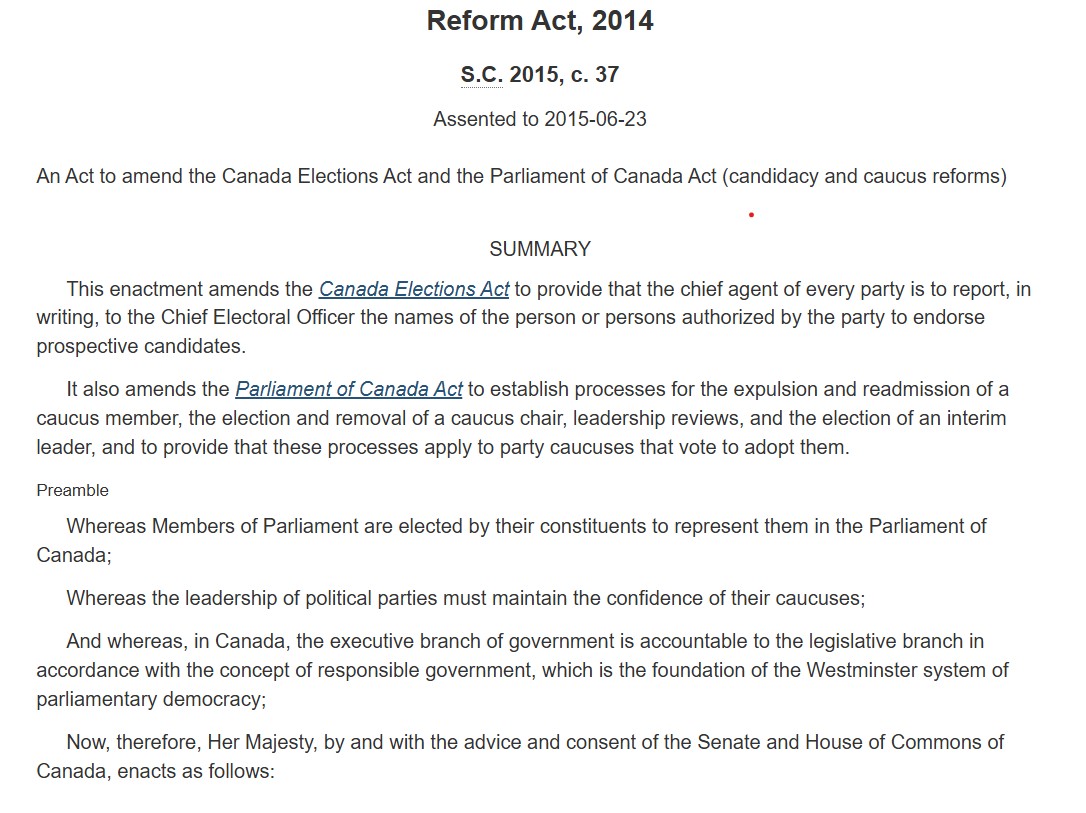
The Canadian Press reported on 6 May 2025 that the MPs-elect of the Conservative caucus for this upcoming 45th Parliament met earlier that day and voted to apply all provisions of the Reform Act to itself once more, as Conservatives MPs did in 2021, though the Conservative caucuses of 2015 and 2019 might only adopted some of the measures.[1] They also decided to name former partyleader Andrew Scheer as their temporary leader in the House of Commons until Pierre Poilievre returns in a by-election this fall. Mark Carney, leader of the Liberal Party and Prime Minister, told reporters on 21 May that the Liberals would hold their first caucus of the 45th Parliament on Sunday, 25 May and hold the four votes required under the Reform Act.[2] The Globe and Mail and The Hub both encouraged Liberal MPs-elect to adopt all the provisions of the Reform Act for the 45th Parliament.[3] The New Democrats, now too few in number, no longer qualify as an official party in the House of Commons and therefore fall outside of the Reform Act in the 45th Parliament. As to the Bloc, I could not care less but expect that they will either vote to reject it or not bother holding the vote at all.
The Reform Act faces its true test this Sunday; if the Liberal caucus votes to adopt any of its provisions, but especially that which gives the parliamentary party a clear means of ousting its leader, this would greatly strengthen the legislation because no party in government has ever adopted any of it before. The Liberals came to regret not having adopted it in 2021 at the beginning of the 44th Parliament; even though Mark Carney saved them from electoral annihilation last month, they might want to gain back some leverage over him, just in case.
Update: 31 May 2025
On Sunday, 25 May 2025, the Liberal parliamentary party voted against adopting any of the procedures under the Reform Act for the life of the 45th Parliament. [4] The Reform Act failed its acid test after all.
Similar Posts:
- Nova Scotia Poised to Repeal Its Fixed-Date Elections Law (February 2025)
- Tim Houston’s Snap Election in Nova Scotia (November 2024)
- Nova Scotia Enacts Canada’s Last Fixed-Date Election Law (January 2022)
- More Arthur Meighen Than Brian Mulroney? Pierre Poilievre Might Soon Confront the Reform Act (April 2025)
- Ousting Party Leaders: From the King Doctrine to the Unenforceable Reform Act (October 2024)
- Dissenting Liberal MPs Fail to Thatcher Trudeau (October 2024)
Notes
[1] The Canadian Press, “Conservatives Choose Andrew Scheer as Interim Opposition Leader in Parliament,” 6 May 2025.
[2] Bryan Passifiume, “Carney Shrugs Off Question about Liberal Caucus Reform Act Consideration,” The Toronto Sun, 21 May 2025.
[3] The Globe and Mail, “A New Chance to Reform the Power of MPs,” 6 May 2025; Kristopher Kinsinger, “Liberal MPs Must Vote for the Power to Remove Their Leader – for the Good of the Party and the Country,” The Hub, 23 May 2025.
[4] Stephanie Levitz and Emily Haws, “Liberal MPs Vote Against Having Power to Remove Carney as Leader,” The Globe and Mail, 26 May 2025.

 James Bowden's Blog