1841 or 1848: When Did Responsible Government Begin?


cover-of-dorchester-review-6-no2

The latest issue of The Dorchester Review contains my first little foray into this question of when Responsible Government began;  I hope to expand this initial contribution into a larger project. For now, you can read my initial findings here.

The idea came to me when I noticed that Alpheus Todd, the Librarian of Parliament for the United Province of Canada and the Dominion of Canada, wrote in Parliamentary Government in the British Colonies that Responsible Government was granted to Canada in 1841. He stated it in a perfunctory way as a matter of fact, not in order to make an argument on a matter of controversy. In other words, the creation of the United Province of Canada itself marked the beginnings of Responsible Government. What made this observation so interesting, in my mind, is that Todd was a contemporary to the Rebellions of 1837 and the re-organization of Upper Canada and Lower Canada into the United Province of Canada and could therefore speak with some authority on the subject. Yet, most historians of the 20th and 21st centuries place the grant of Responsible Government to 1848, when Governor General Lord Elgin first applied the principles contained in his letters and instructions. Canadians elected the 3rd Parliament in January 1848; when it convened in March of that year, the Reformers, let by Baldwin and Lafontaine, used their majority to pass a vote of non-confidence in incumbent conservative administration, and Lord Elgin then commissioned Baldwin and Lafontaine to form a new government. (The custom that the incumbent government resigns before the next parliament meets, when the results and outcomes of the election are clear, did not emerge until the late 19th century).

I explore in this article what accounts for that discrepancy in the historiography of Responsible Government.

Bowden, James W.J. “1841: The Year of Responsible Government?” The Dorchester Review 6, no. 2 (Autumn-Winter 2016): 69-72.

Similar Posts:

Posted in Dorchester Review, History of British North America, Individual vs Collective Ministerial Responsibility, Origins, Responsible Government | 4 Comments

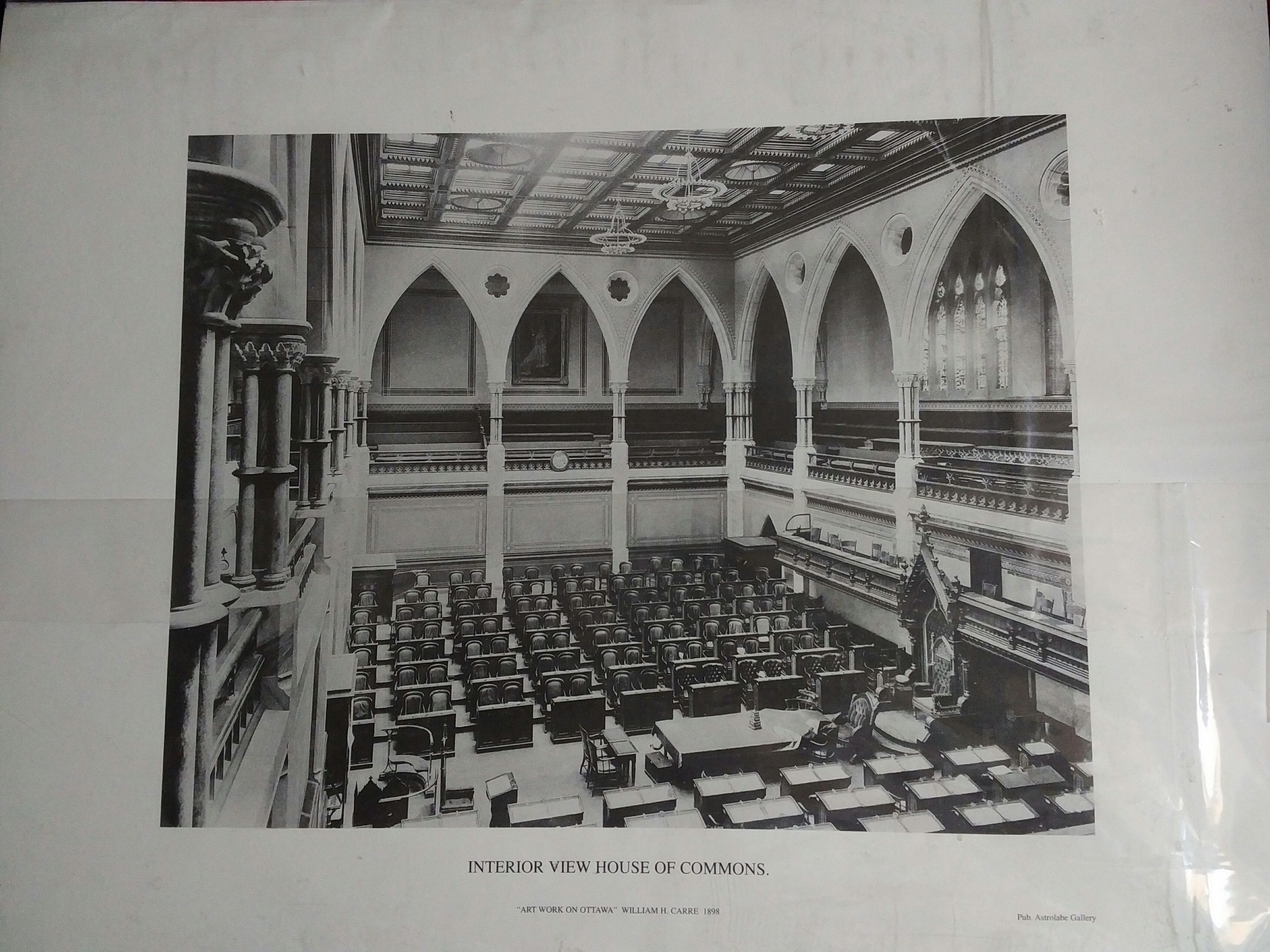
The Old House of Commons Chamber (1866-1916)


The Old House of Commons Chamber

The Old House of Commons Chamber

While I was browsing at the Astrolabe on Sparks Street two days ago (which, sadly, is closing down soon), I happened upon this neat photograph of the old Canadian House of Commons, taken in 1898, 18 years before the great fire destroyed the original Center Block and the Victoria Tower. Library and Archives maintains a collection of official photographs of the interior and exterior of the Old Center Block, but this photo does not appear in the official collection. I have therefore decided to share it with you all because of its historical significance. And, if we’re honest, there is probably a significant overlap between those who would find this old photograph interesting and those who read Parliamentum! At any rate, this photograph deserves to be shared with a wide audience.

This original Center Block and Victoria Tower originally served as the Parliament of the United Province of Canada and became the Parliament of the Dominion of Canada after Confederation. They were built between 1859 and 1866, though judging by the photos and dates in the Library and Archives’ collection, Victoria Tower gained an upper level and spire circa 1870.

As you can see from Library and Archives’ collection, the interior shots of the Old House of Commons are taken from the government side, to the speaker’s right, and therefore show primarily the opposition benches. But this photograph from 1898 was taken from the opposite vantage point and therefore shows a side of the Old House of Commons that most of us haven’t seen before. I thought that the Old House of Commons is in the Uncanny Valley with respect to the current House of Commons; it looks somehow at once familiar yet also strange and unusual. The Old House of Commons was rotated 90 degrees relative to the New House of Commons, so it was wider than it is long. Based on the over-exposure in this and the Library and Archives’ photos, we can see that the Old House of Commons had skylights. Six chairs on the government side look more ornate than all the others, and I suspect that the Prime Minister sat in the chair furthest to the left in this photograph. If that is true, then the Prime Minister and Leader of the Opposition would have sat opposite each other and between the Clerks’ Table, whereas they sit well behind the Clerks’ Table in the New House of Commons. The Speaker’s Throne looks more ornate as well.

Most interestingly of all, the famous portrait of Queen Victoria, which now rests outside the main entrance to the Senate along with portraits of our other sovereigns and which was saved from the Great Fire of 1916, appears in the background of this photo in the galleries. In a way, the Commons is an odd place to put the Sovereign’s portrait, given the convention and parliamentary privilege that the Sovereign cannot enter the House of Commons!

Please let me know in the comments what other interesting things you observe. Merry Christmas!

Similar Posts:


Posted in History of British North America, Parliament, Traditions and History | 4 Comments

Ontario’s Next General Election Has Only Just Been Scheduled for June 2018


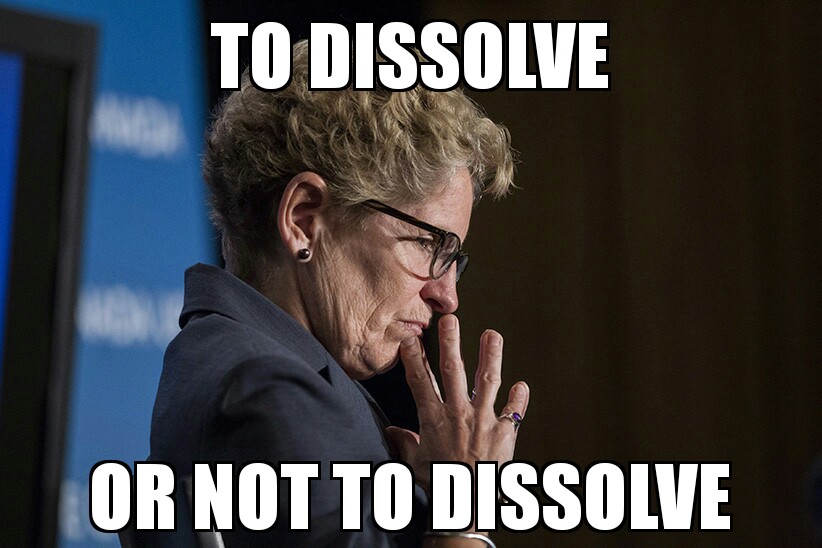
wynnememe

On this subject, I raised the ire of various journalists who accused me of that cardinal sin of pedantry. If I’m pedantic, then they’re obtuse. To declare that a law has been amended even before the government has tabled the bill is sloppy, imprecise, and fundamentally unserious reporting. By this logic, the Star and the Post must report that cannabis has already been legalized merely because the Trudeau government has stated its intention of tabling legislation to that effect in 2017. In any event, this shall be my last update on this subject of the media’s bizarre coverage of this issue, because the bill changing the scheduled date for the next provincial general election has now become law.

As of 8 December 2016, parts of the Election Statute Law Amendment Act have entered into force, including section 7, which states that Ontario’s “general elections shall be held on the first Thursday in June in the fourth calendar year following polling day in the most recent general election.” This amendment means that the current 41st Parliament is now scheduled to live for closer to four years instead of four and one-half years, as it would have been scheduled to endure under the old law just replaced. Prior to 8 December 2016, no one could have accurately reported that the next general election was scheduled for June 2018 instead of October 2018, but various journalists and media outlets did not let accuracy and facts stop them from reporting otherwise.

But as the experience of the last eight years has demonstrated, fixed-date election laws merely limit the maximum life of a parliament and do not prescribe a minimum lifespan. As such, the Premier could advise the Lieutenant Governor to dissolve the 41st Parliament early, well in advance of the scheduled dissolution on 7 June 2018. The Lieutenant Governor of Ontario’s website confirms this interpretation, which is based on fact, experience, and the principles of Responsible Government (though Her Honour needs to update her website now that the legislature has amended the scheduled date!):

“The Lieutenant Governor may therefore dissolve the Legislature on the advice the Premier in circumstances outside of the fixed-date election timeline, such as if:

  • The Government loses a vote of confidence in the Legislative Assembly
  • The Premier is of the opinion that circumstances warrant the calling of a general election.”

Given that First Ministers have been known to wield dissolution as a weapon against restless or disloyal cabinets, we should never forget that this option exists.

Similar Posts: 

Posted in Dissolution, Fixed-Date Elections | 4 Comments

Kathleen Wynne’s Fairy Tale of the Invincible Premier


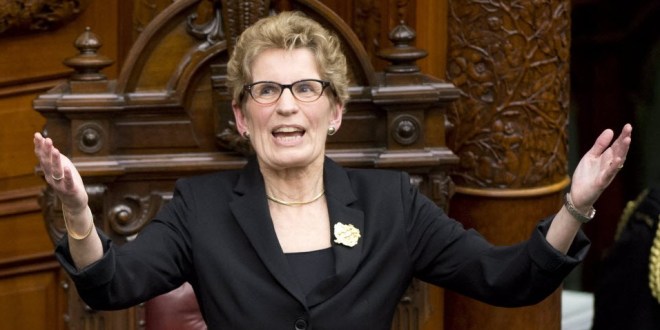
kathleen-wynne

In a recent interview with the Toronto Star, Premier Wynne responded to the lingering suspicions that she will soon resign as leader of the Liberal Party of Ontario and as Premier of Ontario with a novel theory on the authority of the first minister under our system of government. Quite frankly, if Harper had ever said what Wynne said, several scholars would have sharpened their knives and eviscerated him, especially for this assertion:

All the conversations about ‘are the knives out?’ and ‘are people plotting?’ . . . the fact is I’m the premier until either the people decide I’m not the premier or I decide I’m going to step down. That’s how it works.

No, Premier, that’s not how Responsible Government works. And that’s not how prime ministerial succession works either. Perhaps if Eugene Forsey were still alive, he could add Wynne’s statement to his “25 Fairy Tales About Parliamentary Government” as the 26th entry. Of the core Commonwealth Realms, only in Canada could a party leader get away with such a baseless and brazen declaration — despite some recent examples to the contrary. In particular, a prime minister or premier in Australia would never utter such a falsehood, because it could dare the parliamentary party to orchestrate an ad hoc leadership election.

Wynne asserts that only “the people decide” or “[she] decide[s]” when she must resign as Premier, by which she probably has in mind general elections that yield majority parliaments, which see an uneventful transition of power from one party to another, and to intra-parliamentary transitions of power that occur when the leader of the governing party and premier resigns and the new leader of the governing party succeeds as premier. In any event, it is not “the people” who determine whether Wynne will remain as Premier, but rather, the people’s elected representatives.

Her ignorance is all the more extraordinary given that she first became premier in a minority parliament on 11 February 2013 and that she advised the dissolution of that legislature on 2 May 2014, in anticipation that she would lose a vote on confidence on budget later that week. In reality, Premiers can lose power in various other ways. In a minority parliament, the government could lose a vote of confidence, and, if an alternate government could be formed within that parliament, then the governor could refuse the premier’s request to dissolve the assembly and instead appoint a new premier — though this is unlikely.

What is more likely is that the parliamentary party could within a majority parliament decide to replace its own party leader, and, consequently, the premier as well. Wynne should remain mindful of this possibility, given that this fate has recently befallen two Canadian premiers: Premier Dunderdale of Newfoundland was ousted by her own parliamentary party in January 2014, and Premier Redford in Alberta suffered this same fate in March 2014. By Canadian standards, these coups were swift and brutal: Redford announced her resignation on 19 March 2014, and it went into effect on 23 March 2014; Dunderdale announced her intent to resign as party leader and premier on 22 January 2014 and made her resignation effective the following day. In both cases, the PC Party of Newfoundland and Labrador and the PC Party of Alberta both opted to appoint “interim leaders” who, by virtue of their parties’ respective parliamentary majorities, the Lieutenant Governors were obliged to appoint as Premiers as well. In this respect, Canadian political parties differ from Australian political parties. In Australia, parties both oust leaders and elect leaders. But since all Canadian political parties, according to their respective party constitutions, elect their leaders through either delegated conventions or direct vote of party members, and since this process generally takes several months, the parliamentary parties must nominate interim leaders who will lead the party and their own quasi-caretaker government during this time.  In Canada, parliamentary parties do occasionally oust their leaders, but they never elect anything more than interim leaders.

If Wynne is not careful, the parliamentary party and cabinet could very well decide that she will follow in the footsteps of Dunderdale, Redford, and Chretien.

Wynne also alluded to Pierre Trudeau’s proverbial “walk in the snow” of 1984 for the benefit of Canadian politicos.

“I’ll be walking in the snow and on the beach, but I’m not going. I am going to be here through the 2018 election,” the premier said, conceding “of course I feel a sense of responsibility” that her unpopularity could be harmful to Liberal MPPs’ re-election chances. “I wouldn’t be honest if I said I didn’t feel responsibility — for sure.”

Wynne has this extraordinary ability to make statements which sound superficially reasonable, but which are in fact very presumptuous and even a bit mendacious. Wynne should not merely feel responsibility for her policies; in fact, she is responsible for them in every constitutional, legal, moral, ethical, factual, and practical sense. Our system of government necessarily means that Cabinet is collectively responsible for every policy that it puts forth. And both the principles of responsible party government and recent political experience over the last three years show that the Cabinet and parliamentary party both wield significant power and determine whether a party leader and premier can continue in those roles. But for whatever reason, the media and the academy are quite content in letting Ontarians forget it.

Similar Posts:

Posted in Crown (Powers and Office), Formation of Governments, Succession (Prime Minister) | Leave a comment

Stop Appealing to the Governor General To Overthrow Responsible Government


Introduction

Members of Parliament on the Opposition benches need to stop asking the Governor General of Canada and the Queen of Canada to overthrow Responsible Government. This should go without saying, but, alas, it does not. Responsible Government has so effectively reconciled the medieval principle that the Queen can do no wrong with the modern principle of democratic self-government that sometimes even Members of Parliament themselves in opposition call on the Governor General to assume the mantle of a wise and just philosopher-king when they can only but protest the ministry’s policies. We’re all happy with Responsible Government — except when things don’t go our way.

Over the last five years, we’ve seen several examples of this phenomenon, notably from Liberal MP Bob Rae in 2011 (as he was at the time), the lone Green MP Elizabeth May in 2012, and now from Conservative MP Michelle Rempel in 2016.

Three Bad Precedents

In 2011, Bob Rae, then the interim leader of the Liberal Party, sent a letter to Governor General Johnston and asked that he delay giving Royal Assent to a bill that the House of Commons and Senate had passed correctly.

As Leader of the Liberal Party, I would ask most respectfully that full consideration be given to awaiting final disposition of this matter before the courts before legislation receives Royal Assent.

As leader of the Liberal Party, Bob Rae had no standing to advise the Governor General on any constitutional matter. Interestingly enough, Rae had also presumed in one of his questions in the House of Commons that Cabinet has the authority to “ask the Governor General to give royal assent to the law”. In fact, the Governor General does not grant Royal Assent to bills on the advice of Cabinet, but rather, as the preambles to most bills say, “by and with the advice and consent of the House of Commons and Senate.” The Parliament of Canada consists of the Queen, Senate, and Commons. In other words, the Governor General gives Royal Assent in his capacity as representing the Queen of Canada as legislator, not the Queen as executor.

May's Letter to the Queen

Not to be outdone, Elizabeth May, Leader of the Green Party and its lone MP, one-uped Bob Rae and wrote a letter to the Queen of Canada dated 30 August 2012 and appealed to Her Majesty to undermine Responsible Government. Specifically, May asked the Queen to act in place of the Governor General and substitute the advice in her letter for the advice of the Canadian Prime Minister and Cabinet in order to call a royal inquiry on the conduct of the 41st general federal election, which would “restore Canada to a free and fair democracy.” After all, nothing could restore democracy more quickly than undermining Responsible Government itself. The Palace wrote back on 18 March 2013 and provided May with a succinct response on how Responsible Government works:

“Perhaps I should explain, however, that this is not a matter in which the Queen would intervene. As a constitutional Sovereign, Her Majesty acts through her personal representative, the Governor-General, on the advice of her Canadian ministers, and it is to them that your appeal should be directed.”

If you understand the subtleties upper class British English, then you have no doubt also spotted the hilarious condescension that Elizabeth May received and so richly deserved. “Perhaps I should explain,” “which you feel is currently being infringed,” “Nevertheless, “Her Majesty was interested to know your views.”

Michelle Rempel, Conservative MP and aspiring future leader of the Conservative Party, has continued in the deplorable tradition of Bob Rae and Elizabeth May by not only spreading misinformation about the established constitutional positions of the Governor General and Prime Minister in our system of Responsible Government works, but also by calling on her Twitter followers to bombard His Excellency with irrelevant and non-constitutional opinions on why he should overthrow Responsible Government and refuse to implement the Prime Minister’s constitutional advice.

Rempel says, “Governor General Johnston is the federal viceregal representative of our head of state. Justin Trudeau technically can’t order him anywhere.” Rempel says, “Governor General Johnston is the federal viceregal representative of our head of state. Justin Trudeau technically can’t order him anywhere.” She further suggests that her follows contact Rideau Hall and ask that the Governor General not represent Canada at Castro’s funeral. Technically, Trudeau can in fact order Johnston to represent Canada at the funeral of the late Cuban dictator Fidel Castro. Rempel is wrong on this matter of fact — and, frankly, as a current Privy Councillor and former cabinet minister, she should know better. The normative question as to whether Prime Minister Trudeau ought to advise Governor General Johnson to represent Canada at the funeral is separate from the fact that, constitutionally, he is well within his rights to do so. And since the Governor General acts on ministerial advice, Trudeau must still take responsibility for Johnston’s attendance just as much as if he himself had decided to go, which was almost certainly his original intention before the controversy around his deplorable and obsequious white-washing of Castro’s dictatorship erupted.  Canadians and MPs may write letters to His Excellency expressing their personal opinions, but under no circumstances could the Governor General act in accordance with public opinion against the advice of his ministers.

To be fair, Bob Rae and Elizabeth May seemed far more committed in their appeals to the Governor General and Queen, respectively, to overthrow Responsible Government, since they wrote formal letters to them, than does Michelle Rempel, whose tweets seem half-hearted. While, as a matter of policy, I share Rempel’s disdain for Prime Minister Trudeau’s obsequious and mendacious white-washing of Fidel Castro’s dictatorship, our response cannot involve undermining our own system of government.

Conclusion: What Responsible Government Means

At its core, Responsible Government is a trinity (three in one) of responsibilities: ministerial responsibility to the Crown, individual ministerial responsibility before the Commons, and collective ministerial responsibility & solidarity before the Commons.[1] In this manner, Responsible Government therefore preserves and fully incorporates the medieval principle of Royal Infallibility and reconciles it with liberal democracy and self-government: the Queen can still do no wrong because it is the ministry which takes responsibility for all acts of the Crown, for good or ill. Responsible Government means that “Ministers of the Crown take responsibility of all acts of the Crown”[2] and that the Governor General acts on and in accordance with ministerial advice, save for exceptional circumstances.[3] These acts include accepting responsibility for one’s own appointment as Prime Minister, the dismissal of one’s predecessor, and for dissolving parliament. Logically, therefore, we cannot drive a wedge between the Queen or Governor General on the one hand and the Prime Minister and Cabinet on the other; under no circumstances could the Queen or Governor General act independent of ministerial advice on matters of state,  and only under exceptional circumstances could the Queen or Governor General act contrary to ministerial advice.

The Queen or Governor General can only refuse to promulgate ministerial advice in exceptional circumstances because the consequence of exercising such discretionary authority is equally and proportionately exceptional: the Governor General thereby dismisses the Prime Minister and ministry which tendered the original constitutional advice and must appoint in their place a new Prime Minister and ministry which can then take responsibility for the Governor General’s decision to refuse advice and force the dismissal of their predecessors.[4] Ultimately, the Constitution Act, 1867 does in fact partially codify these basic principles of Responsible Government, contrary to scholarly belief.[5] Section 10 states that the Governor General acts “on behalf of an in the name of the Queen,” section 12 states that the Governor General acts alone (thus, conventionally, on the Prime Minister’s advice) or on the advice of the Privy Council (thus, conventionally, on the Cabinet’s advice), and section 13 further clarifies that the Governor-in-Council refers to “the Governor General acting by and with the advice of the Queen’s Privy Council for Canada” (and thus, conventionally, on the advice of Cabinet). Furthermore, sections 53 and 54 state that money bills must be introduced by the people’s elected representatives in the House of Commons and that the Ministry must take responsibility for, and therefore give sanction to, all money bills.

One must distinguish discretionary policy matters from necessary constitutional norms. Obviously, based on my post yesterday, I disagree with the Prime Minister’s policy on and general attitude toward Cuba, but that does not warrant calling into question the system of government itself. It is the Prime Minister who takes responsibility for the constitutional advice that he tenders to the Governor General, and it is therefore Prime Minister Trudeau who must respond to all criticism for having advised Governor General Johnston to attend and represent the Dominion of Canada at the funeral of the late dictator Fidel Castro. We must never let MPs or Cabinet Ministers themselves forget who takes responsibility before the Commons and the people for all decisions of government.

Responsible Government becomes untenable and impossible if the Governor General can simply refuse to act on the Prime Minister’s advice without reason or consequence.

Similar Posts: 

[1] Robert Macgregor Dawson, “The Constitutional Question,” Dalhousie Review VI, no. 3 (October 1926): 332-337; Eugene Forsey and Graham C. Eglington, The Question of Confidence in Responsible Government (Ottawa: Parliament of Canada, 1985), 16-17.

[2] Sir John George Bourinot, Parliamentary Procedure and Practice, 4th ed. (Montreal: Dawson Brothers Publishing, 1916): 102.

[3]  R. Macgregor Dawson, The Government of Canada. 5th ed. (1970), revised by Norman Ward (Toronto: University of Toronto Press, 1947): 175.

[4] Sir John George Bourinot, Parliamentary Procedure and Practice. 1st ed. (Montreal: Dawson Brothers Publishing, 1884): 58.

[5] Janet Ajzenstat, The Once and Future Canadian Democracy: An Essay in Political Thought (McGill-Queen’s University Press, 2003), 64, 66-67.

Posted in Reaffirmation of, Responsible Government | 1 Comment